Wednesday, August 25, 2010

Hsieh PJM OpEd: "Avastin and Your Life"

PajamasMedia has just published my latest OpEd, "Avastin and Your Life".

Here is the introduction:
The Food and Drug Administration (FDA) is on the verge of taking the highly unusual step of "decertifying" the cancer drug Avastin that it had previously approved.

In addition to sparking concerns that this is another step towards medical rationing, the FDA's proposal will worsen another important but less-frequently recognized danger of government-run health care -- namely, the politicization of health benefits. Both problems will accelerate under ObamaCare unless our politicians repudiate the principle of government-run health care...
(Read the full text of "Avastin and Your Life".)

Tuesday, August 24, 2010

Fast Track To Government Health Care

Grace-Marie Turner explain how regulators' interpretation of the seemingly arcane "medical loss ratio" could determine whether private insurance survives as an industry, or whether it becomes a back-door path to a government-run "single payer" system.

Her piece in the August 20, 2010 Investors Business Daily is entitled, "Fast Track To Government Health Care".

Here's more political wrangling over the same issue: "Debate Heats Up Over Medical Loss Ratios".

Monday, August 23, 2010

Economist on Consumer DNA Testing

The Economist has a short series of articles on consumer DNA testing:
"What lies within" (The personal genetic-testing industry is under fire, but happier days lie ahead)

"Reading genes" (Alas, a DNA test probably won’t reveal your future. But a crackdown on consumer genetics is unwise)

"The part where I find out that I may get fat" (What our science correspondent found out about herself when she tried commercial gene testing)

"The part where I find out the government doesn't like what I'm doing"
(My own piece on this topic is available at PajamasMedia: "Should You Be Allowed to Know What’s in Your DNA?")

Thursday, August 19, 2010

Pipes: Why ObamaCare Must Be Repealed

In the August 17, 2010 RealClearPolitics, Sally Pipes discusses "Why ObamaCare Must Be Repealed".

She draws on the experience in Canada and Massachusetts to show how ObamaCare's proposed incremental "reforms" will inevitably lead to a full government takeover of American health care. Here's an excerpt:
Obamacare promises to expand coverage in the same way that Massachusetts did -- by expanding government-funded insurance. Canada did the same thing. Worse, Rep. Lynn Woolsey (D-CA) - introduced on July 21 an amendment to the Affordable Care Act, backed by 128 lawmakers, to bring back the "public option" that failed to make it into the final health reform package.

To pay for all this new coverage, Obamacare introduces a number of new taxes on individuals and businesses. Once the Treasury has its hands on all that new revenue, it's unlikely that it will ever be able to let go. Those taxes will be here to stay.

And when costs spiral out of control -- as they have in Canada and in Massachusetts -- American officials will likely double-down on their bets and seize ever-greater control of the healthcare system. Canada banned the private delivery of medicine in response to runaway costs, while Massachusetts sees a system of global per-patient budgets as the solution to its cost problems. Federal officials will no doubt implement some combination of the two...
(Read the full text of "Why ObamaCare Must Be Repealed".)

It's still not too late to repeal it!

Wednesday, August 18, 2010

Colorado Updates

In the August 14, 2010 Wall Street Journal, Stephen Moore describes some of the obstacles that had to be overcome in order for the Colorado Health Care Freedom Act to qualify for the November ballot. The details can be found in his piece, "Health Care Freedom Comes to Colorado".

In the August 9, 2010 Colorado Springs Gazette, Seth Richardson discusses the benefits of that initiative in his piece, "Opposing Obamacare with the 'Right to Health Care Choice' initiative".

Brian Schwartz explains why the CO initiative is not just a PR stunt. Instead, it's carefully crafted to avoid the standard objection of "a state law (or state constitutional amendment) can't trump federal law".

(First two links via StateHouseCall.)

Update: One sharp-eyed reader noted a minor inaccuracy in the Moore WSJ piece. The CO initiative does not block any federal law. Instead it blocks any state-level measures to require residents to purchase health insurance. Also, it's not yet officially on the ballot.

Off Topic: Hsieh OpEd on NYC Mosque

Off topic: For those who are interested, the August 17, 2010 American Thinker has published my OpEd, "The Real Problem Is Not the Mosque But the Nukes".

My theme is the NYC Mosque would become a non-issue if the US would adopt a proper foreign policy, explicit identify our enemy, and take the necessary action against Islamic Totalitarianism and its primary state sponsor Iran.

I also cite and quote John Lewis' article from The Objective Standard, "No Substitute for Victory" as an example of the approach our current political leaders should adopt.

Tuesday, August 17, 2010

Hsieh PJM OpEd: "Transparency For Me, But Not For Thee"

PajamasMedia has just published my latest OpEd, "Transparency For Me, But Not For Thee".

My theme is that our government's ever-increasing demands for access to our personal data while simultaneously preventing us from gathering information about it threatens to turn America into a chilling "interrogation room society" where transparency only goes one way. Hence, Americans must demand government transparency as a corollary to the broader principle of properly limited government.

Here is the opening:
When President Barack Obama took office, he pledged to make his administration "the most open and transparent in history." However, government officials are now demanding ever-increasing amounts of information about ordinary Americans, while preventing citizens from gathering similar information about government operations. If this ominous trend continues, this "transparency" will be in one direction only -- which bodes ill for the future of our republic.
(Read the full text of "Transparency for Me, but not for Thee".)

Monday, August 16, 2010

The Specialist Wall

Physician-blogger "911doc" describes the latest response of specialists to federal EMTALA requirements that they treat emergency room patients for free, regardless of need.

Here is an excerpt from his post, "The Specialist Wall":
If you are unfamiliar with EMTALA or our take on it you can read about it here, but to be brief, EMTALA is an unfunded federal mandate passed in 1986, which, de facto, has made it a crime to tell anyone 'no' in the ER. Because of this, the specialists on call have learned to hate the ER. The ER is no longer a place from which one can build a practice, it is, rather, a place that compels you lose sleep, and money. It compels consultants to expose themselves to full malpractice liability EVERY SINGLE TIME they accept a patient from us whether they ever get paid or not.

No doubt there is a strong tradition in western medicine to treat first and seek payment later. This dates to Hippocrates and is part of the original oath. My question is this. How far should this obligation extend, AND, should it be extended by force of law rather than by individual choice?

...[T]he specialists are fed up, and they have figured out how to fight city hall. For years their battle has been against the system or even the ER doc downstairs. But now (oh the genius!) they have turned the bureaucrats game against them. EMTALA and the bylaws, policies, and rules that it has generated are being followed to the letter.

For instance, almost all hospitals have an on-call policy for specialists that require them, if the ER doc requests it, to come in to the ER and evaluate the patient. Well, they can be forced to do this, but in many cases they CAN NOT be forced to treat the patient. Unheard of twenty years ago and before EMTALA, but specialists are now routinely coming in, evaluating the patient, and finding reasons why this particular case is out of their area of expertise, or not appropriate for their care, or not in need of surgery immediately, and the specialists are going home.

Recently, a child came in to the ER after sustaining a facial laceration. Two different surgeons were called to fix the cosmetically sensitive but clearly non-emergent laceration. Both came in, and both told the ER doc, "No issue, you can do this." And that's exactly what happened -- the ER doc sewed it up (I hope he did it well). And that's exactly what EMTALA means, and exactly what Obamacare means, and it ends up hurting people who do not deserve it, and it ends up rewarding those that do not deserve it. And yes, I said "DESERVE", and yes, I mean it. Punishing the doers eventually causes them to slip the yoke.
(Read the full text of "The Specialist Wall".)

This is a tragic (and predictable) consequence of the notion of an automatic "right" to health care. Attempting to create such a right necessarily enslaves those who must be compelled to provide such care. Many doctors will refuse to work under such terms, recognizing the gross injustice of such attempted automatic claim upon their time and expertise -- especially when it only brings them medico-legal risk with no compensation.

I thank for "911doc" for analyzing this important issue at a deeper moral level (rather than at simply the economic level), for showing how bad ideas will have real-life consequences for patients and doctors, and for speaking his conscience.

Friday, August 13, 2010

Medicare Miscounting

The August 10, 2010 Chicago Tribune summarizes the various bad accounting tricks and assumptions used to falsely bolster the fiscal health of Medicare.

Here's an excerpt from "Medicare's Rosy Health*":
For example: The report assumes that Congress will deeply slash doctors' Medicare pay. Congress has threatened to do so, but has always backed off. That's the infamous "doc fix." The doctors are due for a 23 percent pay cut in December. Congress will back down, as it always does.

Scratch about $250 billion to $300 billion in "savings" over a decade.

...Another example of the absurdity of these projections: Under an inflation formula imposed by the new law, Medicare payments would tumble below the abysmally low Medicaid payments by the end of the decade. They'd fall from nearly 80 percent of private insurance prices now to about 50 percent by 2050. That would squeeze many doctors, hospitals, surgical centers and other providers into oblivion.

Long before that happens, hospitals and other facilities will stop treating Medicare patients and raise costs for private patients...
(Read the full text of "Medicare's Rosy Health*".)

Sooner or later, reality will always catch up with bad accounting. The only question is when.

Thursday, August 12, 2010

Haynes on Social Justice and Medical Ethics

Dr. Beth Haynes of the Black Ribbon Project makes some insightful observations about the recent push to teach "social justice" to medical students.

Here's an excerpt from her essay, "Social Justice and Medical Ethics":
Since 2005, the "Initiative to Transform Medical Education" has been working to correct what it views as deficiencies in the current training of phsicians. These include an over-emphasis on the ability to acquire knowledge and problem solve-- to the detriment of "caring." Traditionally, physicians have expected to be autonomous decision-makers -- but that clashes with "increasing requirements...to be more accountable to various constituencies, including...the public, payers and government." Although physicians are recognized as "prepared to do what they believe is best for individual patients... [t]hey are not...prepared to participate in ethical and political discussions about the allocation of health care resources, which are not limitless."

"Social justice" is a euphemism for economic egalitarianism--and since people do not naturally come by equal wealth, "social justice" requires taking from some to give to others. "Social justice" is in direct conflict with the principles of equality before the law and the right to private property. "Social justice" also requires that a physician NOT advise his patients solely based on what is in the patients own best interest. He must instead somehow "balance" the patient's interests with those of the rest of society.
This collectivist view of "social justice" places doctors at odds with their Hippocratic Oath to do their best for the individual patient. Yet this is what our government attempting to force doctors to do.

Dr. Haynes goes on to explain the proper way to approach medicine -- as a business in which physicians and patients exchange value for value as traders in a free market. In other words, capitalism:
Capitalism is nothing more than individual rights applied to trade. Profits, in medicine as in any economic transaction, are not gained by exploiting patients or customers. Profits are simply the proper reward for successfully offering a value to others which is worth more to them than it costs to produce. In a system of free trade, self-interests are not in conflict -- not even between a physician and a patient. In a direct-pay, fee-for-service relationship, it is in the best long term interest of the physician to offer advice and treatment based on the patient's best interest. And, it is in the best long term interest of the patient to only deal with a physician who does!

We can not defend patients' freedom without also defending the freedom of physicians. We can not protect the doctor-patient relationship without protecting the autonomy of both. Freedom of association and freedom to contract are interrelated principles fundamental to a free republic, to capitalism and to the ethical practice of medicine. "Social justice" requires that the individual be sacrificed to the collective. Such an act is as immoral in medicine as it is anywhere else.
Read the whole thing.

And if you like her work, feel free to contribute to the Black Ribbon Project!

Wednesday, August 11, 2010

What To Expect Under Berwick

Dr. Richard Amerling of AAPS explains "What to Expect Under the Reign of Berwick".

Here's an excerpt:
How will standardized care be implemented? One route will be the electronic health record (EHR). They cite the example of HealthPartners in Minnesota who, in order to cut down on the use of high-tech imaging procedures "incorporated appropriateness criteria for radiological tests into the EMR as a reminder to primary care doctors."

There will also be a "primary focus on changing professional practice culture through the engagement of physicians in developing and implementing practice standards. The framework derives partly from known principles and methods of guideline or protocol development." They suggest starting small with "selective, smaller scale efforts to reduce overuse," as this will "prepare the local culture for broader changes in the future."

There can no longer be any doubt that this is what the future holds should ObamaCare survive the dozens of legal challenges. The underhanded recess appointment of this devoted central planner confirms our grim predictions. There is also no question this approach will fail, and fail on a grand scale. There will be shortages, dislocations, more massive bureaucracies, huge cost overruns, and what may be an irreversible loss of quality. Along the way, thousands, if not millions of patients will be harmed.
(Read the full text of "What to Expect Under the Reign of Berwick".)

The government will seek to control ever-increasing aspects of health care in the name of "efficiency" and "standardization". But once you give the government control over the people's health, you've given it control over their lives. Our freedoms and our individual rights will be the inevitable casualties.

Tuesday, August 10, 2010

Ten Inconvenient Truths

Dr. Richard Reece lists 10 "Inconvenient truths about our health care system".

Here are a couple of examples:
4. The next political crisis will be limited access to doctors; this is already occurring in Boston, where waiting times to see doctors are 2 to 3 times the national average for comparable cities.

7. Passing federal laws permitting patients to enroll in plans and "portability" of plans across state lines would make a public option unnecessary and would render private plans "competitive."

8. Ending "community ratings," which force the young to pay the same premiums as older individuals, and reducing "standard benefit plans," which often include unnecessary benefits, would reduce premiums for the young and decrease the number of uninsured.
Read the whole thing.

(My only comment is that I don't think we should try to salvage Medicare by patching the low rates paid to primary care physicians; instead we should gradually phase the program out entirely and privatize it.)

Monday, August 9, 2010

Get Ready For the Bureaucracy

How much bureaucracy will we be in for under ObamaCare? Nobody knows -- not even Congress.

According to this recent article in Politico, "Health reform's bureaucratic spawn":
Don't bother trying to count up the number of agencies, boards and commissions created under the new health care law. Estimating the number is "impossible," a recent Congressional Research Service report says, and a true count "unknowable."

The reasons for the uncertainty are many, according to CRS's Curtis W. Copeland, the author of the report "New Entities Created Pursuant to the Patient Protection and Affordable Care Act"...
(Read the full text of "Health reform's bureaucratic spawn".)

What we do know is that costs will continue to go up and freedoms go down.

Saturday, August 7, 2010

Green Light for Paul Hsieh's Top-Tier Op-ed

[From Diana.]

I'm pleased to announce that, thanks to your generous pledges, Paul Hsieh will be diligently working on publishing an op-ed on a top-tier paper over the next few months. Hooray!

Many thanks to those of you who pledged -- 48 people in total! You've made this step-up in Paul's activism worth his extra time and effort. But please don't send any money now... Paul has to publish the op-ed for any of us to owe him so much as a cent. (Yes, I pledged!)

The pledge form will remain active until Paul publishes the op-ed -- or until the deadline expires at the end of 2010. (Let's hope for the former!) So if you missed the original pledge drive but wish to offer Paul some additional motivation, you're welcome to pledge below.

Our many, many thanks to everyone who pledged. It's so gratifying to see people support Paul's work, as we've seen here. It's major spiritual fuel for us -- and I hope for you too!

Here's the pledge form:

Friday, August 6, 2010

How's That Swedish Universal Care Going?

John Stossel discusses the latest medical outrage in Sweden in his blog post, "Great Moments In Government-Run Health Care":
...What really astounds me is not that a Swedish man sewed up his own leg after waiting for a long time in a hospital. Heck, I wouldn't be surprised if things like that happened in all nations.

The really disturbing part of the story is that the hospital then reported the man to the police. A classic case of "blaming the victim." The bureaucrats in Sweden's government-run healthcare system obviously were not pleased that he called attention to their failure.
Here's the original news story.

Thursday, August 5, 2010

Lucidicus Interview With Peter Schiff

The Lucidicus Project has a nice interview with US Senate candidate Peter Schiff.

Schiff gives several good suggestions for free market health care reforms. Read the whole thing!

Wednesday, August 4, 2010

Brook: How To Free Health Care

From ARC-TV:
Yaron Brook presents a series of concrete suggestions on how to bring us closer to a free market in health care. This is an excerpt from the Q-&-A session of a talk that Dr. Brook delivered at the University of Pennsylvania on May 11, 2010.


Tuesday, August 3, 2010

Virginia Update

David Catron explains the importance of the latest positive court decision on Virginia's challenge to ObamaCare.

Ilya Somin offers some additional legal analysis.

Monday, August 2, 2010

Market Shift

Are Americans really cutting back on health spending, as the Wall Street Journal suggests?

Professor Mark Perry argues that they're just spending their money more efficiently:
Consumers aren't necessarily consuming less health care like the WSJ suggests; rather, they are shifting their demand for health care away from expensive, conventional physician offices with limited hours to affordable and convenient retail clinics. Especially when consumers are spending their own out-of-pocket money for health care and they have a choice, they prefer market-driven, consumer-driven options like affordable, convenient retail clinics over conventional physician offices.
People can be rational actors when it comes to their health spending. We need the government to respect that fact, and protect our freedom to act in our medical self-interest.

(Via K.V.)

Friday, July 30, 2010

Brook: "You Are Not Your Neighbor's Health Care Provider"

The Ayn Rand Center for Individual Rights now has the full video of Yaron Brook's lecture, "You Are Not Your Neighbor's Health Care Provider":
This talk by Yaron Brook was recorded at the University of Pennsylvania on May 11, 2010 as part of the ARC Speaker Series.

Despite overwhelming evidence that government intervention wrecks health care, government control over American medicine keeps growing. Why?

Because, Dr. Brook argues, virtually everyone today believes that a person’s need morally entitles him to have it fulfilled at others’ expense. This morality of need is at the root of every government health care entitlement, from Medicaid to ObamaCare .

In this provocative talk, Dr. Brook attacks the morality of need , and proposes a revolutionary alternative: the moral right of each individual to live for his own sake, taking responsibility for his own life and needs—including his health care needs—on a free market.
Watch the talk here.

Thursday, July 29, 2010

Parkinson on Paying Cash

Dr. Jay Parkinson explains how working out a cash-pay arrangement with his own physician saved him money, and improved his care.

Read the details at, "Paying cash to doctors affects the treatment plan".

This is one of the strategies I discuss in my article, "How To Protect Yourself From ObamaCare" in the Summer 2010 issue of The Objective Standard.

Wednesday, July 28, 2010

Who's Lying Now?

The July 23, 2010 Las Vegas Review-Journal has a nice summary of President Obama's flip-flopping on whether the individual mandate is a tax or not.

Here's an excerpt from "Health Care Lies":
...[W]hile Congress was working on the health care legislation, Mr. Obama refused to accept the argument that a mandate to buy insurance, enforced by financial penalties, was equivalent to a tax. "I absolutely reject that notion," he said emphatically.

Why? Because Mr. Obama was loathe to admit he'd massively violated his campaign pledge not to raise taxes on anyone but the rich, presumably...

In a brief defending the law, the Justice Department says the requirement for people to carry insurance or pay the penalty is "a valid exercise" of Congress's power "to impose taxes."

...One of two things is true, here.

Either the mandate is a tax, as the Obama Justice Department now asserts in court, and President Barack Obama lied to the American people -- loudly, firmly, repeatedly, as he worked to get this massive federal power grab enacted -- or else Barack Obama was telling the truth last year, the penalty is not a tax, and the Justice Department (directly answerable to the president) is lying in court today when it asserts no one can challenge the mandate because it falls under the wide-ranging "taxing authority" ... that it's a tax.

Someone's lying: either Barack Obama or Barack Obama.
(Via @TOSjournal.)

Tuesday, July 27, 2010

Quick Links: Samuelson, Barnett, NHS

In the July 19, 2010 Washington Post, Robert Samuelson warns, "As Massachusetts health 'reform' goes, so could go Obamacare".

The July 23, 2010 Wall Street Journal has an interview with Randy Barnett over the constitutionality of ObamaCare.

The July 24, 2010 Telegraph described the next round of "astonishingly brutal" rationing planned for the British National Health Service.

Monday, July 26, 2010

Pledge for an Op-Ed by Paul Hsieh in Top-Tier Newspaper

Note: I'm Diana Hsieh, posting with Paul's permission.

As you likely know, Dr. Paul Hsieh is an op-ed writing machine. He published a handful of op-eds in 2007 and 2008, then 13 in 2009. This year, in just seven months, he's published 18 op-eds. That's an impressive output, to say the least. It's in addition to five articles published in The Objective Standard. Perhaps most remarkably, Paul does that work purely in his scarce free time -- in evenings and weekends, often after long days in a very busy radiology practice.

Since early 2009, Pajamas Media has become Paul's favorite outlet, such that most of his op-eds this year were published by them. That makes sense. Pajamas Media is eager for his work, they're great to work with, and his op-eds get widely circulated and discussed on the internet.

Paul speaks about trying to publish in the top-tier national newspapers on occasion. By that, he means:
  • Wall Street Journal (#1, with circulation of 2,092,523)
  • USA Today (#2, with circulation of 1,826,622)
  • New York Times (#3, with circulation of 951,063)
  • Washington Post (#5, with circulation of 578,482)
For Paul to publish an op-ed in one of those venues would mean so much more exposure for his ideas than any online outlet or regional paper. He's experienced a taste of that with his two op-eds in the smaller but well-respected Christian Science Monitor, and even with his letters published in the New York Times and the Wall Street Journal.

However, any serious attempt to publish an op-ed in any of those four top-tier venues would require much additional work for Paul. The op-ed couldn't just be solid: it would have to be a work of art. The submission process would be far more cumbersome than with Pajamas Media too. Consequently, he's not pursued it seriously.

Here's my proposal... Let's help motivate Paul to publish in one of those top-tier national newspapers!

I'm asking you to join me in pledging to pay Paul Hsieh a bonus if he publishes an op-ed in the print edition of any of those four top-tier papers by the end of 2010. The topic -- and what he says about it -- will be entirely up to him.

Paul needs to start his work on this project as soon as possible. However, he'll be extra-busy with work through August 6th. That gives us some time to gather pledges. If we've raised enough funds by noon on August 6th to justify the additional work required for him, then he promises to make a serious effort to publish in one of those top-tier papers. (The more money that's pledged, the more serious his effort, I suspect!) So on August 6th, I'll announce whether the project is moving forward or not.

Publishing an op-ed in a top-tier paper is no small feat. Paul knows that, and he's not sure that he'll be able to do it by the end of 2010. You're not pledging for effort; you're pledging for results. So if he's successful, then you'll owe him your pledge when he publishes. But if he's not, you'll owe him nothing.

If you value Paul's work -- if you want to inspire him to new heights -- please pledge!

In your comment, I'd love if you would say something about why you've decided to pledge. In other words, what does Paul's work mean to you? I might post some of those, but I'll do so anonymously, unless you request otherwise. Your pledge amount will remain private no matter what.

Here's the form to pledge:


If you have any questions, please e-mail me at diana@dianahsieh.com. And thank you!

Friday, July 23, 2010

Hsieh PJM OpEd: Berwick, Gun Control, and Paternalism

The July 23, 2010 PajamasMedia has published my latest OpEd, "Donald Berwick, the Pro-Gun Control Lobby, and Paternalism".

My theme is that both Donald Berwick and gun control advocates share a flawed view of human nature and a disdain for the rationality of ordinary men. This explains their paternalistic desire to restrict our freedoms.

Here is the introduction:
Q: What do Donald Berwick and gun control advocates have in common?

A: Both distrust ordinary Americans' ability to exercise individual rationality and responsibility. Instead, they believe that the government should restrict our freedoms for our own good. And if they have their way, we'll end up paying the price.

Dr. Donald Berwick is President Obama's newly appointed head of Medicare and an unabashed supporter of socialized medicine. He has repeatedly praised the British National Health Service as a model for the United States to emulate.

The Wall Street Journal recently published a selection of Berwick's public statements on health policy. Two in particular stand out because they are such naked attacks on the efficacy of individual choice and rationality:
1) I cannot believe that the individual health care consumer can enforce through choice the proper configurations of a system as massive and complex as health care. That is for leaders to do.

2) The unaided human mind, and the acts of the individual, cannot assure excellence. Health care is a system, and its performance is a systemic property.
Hence, Berwick has explicitly called for doctors to relinquish their "clinician autonomy" and instead follow standardized government treatment guidelines. Patients should forgo using their "unaided human minds" and instead let their "leaders" decide what kind of medical care they should receive.

Many gun control advocates display a similar disdain for the rationality of ordinary Americans. This can be seen most clearly whenever a state considers allowing law-abiding citizens to carry concealed firearms...
(Read the full text of "Donald Berwick, the Pro-Gun Control Lobby, and Paternalism".)

Update: Thank you, Instapundit!

Schwartz at PJM: Exploitation, Not "Reform"

Brian Schwartz of PatientPower has a new OpEd at PajamasMedia, "It's Not Health Care 'Reform'; It's Exploitation".

Here's the introduction:
Scratch a health care "reformer" and you're likely to find a health care exploiter. As ObamaCare's provisions and taxes begin and resistance builds through lawsuits and state-level measures, it's important to see the exploitative motives driving increased political control of your medical care. Health control advocates won't stop with ObamaCare (HR 3590). "Once we kick through this door, there'll be more legislation to follow," said House Speaker Nancy Pelosi.

Whether health control supporters demand that all policies include certain benefits or that everyone must buy government-approved insurance or something like "Medicare for all," the policies don't follow from the alleged justifications for them. But they do follow from one motive: charity at gunpoint. That is, forcing you to finance other people's medical care. This is exploitation. It's about time freedom advocates reclaim this term often misused by the left, as so-called health care "reform" is a clear case of exploitation...
(Read the full text of "It's Not Health Care 'Reform'; It's Exploitation".)

Thursday, July 22, 2010

The Two Types of FDA Errors

Dr. Henry Miller (a former FDA official) explains the two types of FDA errors. And why the lesser-known Type 2 errors are strangling innovation.

Private Insurance Death Spiral

The private insurance death spiral is accelerating as private carriers and small businesses are being squeezed by government regulations.

The July 17, 2010 New York Times reports "Insurers Push Plans That Limit Choice of Doctor".

The July 18, 2010 Boston Globe reports "Firms cancel health coverage".

If the trend continues, the government option will be the only left -- thus backing Americans into a "single-payer" system against their will.

Wednesday, July 21, 2010

OCR Reviews ObamaCare

The July 8, 2010 Orange County Register posted some interesting information about ObamaCare and popular response. In "The future of health care under Obamacare", Brian Calle noted two tidbits:
After Whole Foods CEO John Mackey wrote an OpEd against ObamaCare, his sales went up rather than down. In other words, his willingness to speak out attracted more customers than left due to ineffectual boycotts.

And Wall Street Journal writer Stephen Moore gives several reasons why the only solution to ObamaCare's problems is "repeal, repeal, repeal".
Let's hope more Americans start paying attention!

(Via @Lucidicus.)

Tuesday, July 20, 2010

Quick Links: Doctors' Code, Exodus, UK, FDA

Dr. Michael Kirsch explains what "will discuss with you" and "for completeness" in a medical chart really mean.

In the July 19, 2010 Boston Herald, Grace-Marie Turner describes how new government rules are accelerating the exodus of physicians from Medicare.

The British Medical Journal reports that "UK is ranked top out of 40 countries on quality of death". As one of my physician colleagues notes, "The NHS is really good at killing people."

David Catron discusses more inane FDA mission creep.

Monday, July 19, 2010

Punishing Doctors For Quality Care

Here's the latest example of how new ObamaCare rules could punish doctors who take better care of their patients:
...[F]inancial incentives could actually punish physicians for doing the right thing.

A recent study from Cleveland Clinic shows how this could happen. The Clinic studied hospital readmission rates for patients with heart failure. It is often considered a sign of poor quality care when a heart patient, once released from a hospital, must be readmitted for further treatment. Turns out, this may not be the case at all.

Writes Karen Pallarito for the HealthDay Reporter, the Clinic reasons that “[k]eeping more patients alive for a month in the first place means there are more patients eligible for readmission... They also suspect that assuring appropriate care for these patients, including any necessary procedures or surgery, may necessitate readmission to the hospital -- which would drive up readmission rates.”

The results of the study showed that high readmission rates actually corresponded to lower 30-day death rates. The Cleveland Clinic's 30-day readmission rate for heart failure was 28 percent, 3.3 points higher than the national average. But their 30-day death rate of 8.8 percent was 2.4 points below the national average.

Starting on Oct. 1, 2012, Medicare payments for hospitals with high readmission rates for certain conditions, including heart failure, will be reduced. This means Obamacare may actually punish hospitals and physicians for providing better quality care.
What will happen to American medical care when doctors are punished for keeping patients alive longer (and thus surviving for followup admissions), whereas they get rewarded for having fewer readmissions?

Do you want to be the patient who gets denied care in order to keep a hospital's readmission statistics down?

(Via Dr. Milton Wolf.)

Sunday, July 18, 2010

Catron at PJM on Berwick and Rationing

PajamasMedia has just published an OpEd by David Catron entitled, "Donald Berwick's Motto? Rationing for Thee, but not for Me".

Here is the intro:
If you're like most Americans, you had probably never heard of Donald Berwick before July 7, when President Obama installed him as Administrator of the Centers for Medicare & Medicaid Services (CMS). And, unless you're a health policy wonk, the news that Obama circumvented the normal Senate confirmation process with a recess appointment probably elicited no response beyond a briefly raised eyebrow and a stifled yawn.

But this CMS decision deserves another look. Dr. Berwick has been granted the power to reach out and touch you in ways undreamed of by higher profile appointees like Elena Kagan. Whether you're paying attention or not, he will have a profound impact on the quality of your life...
(Read the full text of "Donald Berwick's Motto? Rationing for Thee, but not for Me".)

The arrogance of government officials like Berwick is astounding in a two-fold way.

First, they believe they are qualified to set draconian rules over the lives of the citizenry, because we are unable to make such decisions for ourselves. The typical excuse given is that it's for our own good or for some nebulous "common good".

But by exempting themselves from their own rules, they recognize (at some level) that these rules are actually bad for the individuals involved -- but they don't care.

This isn't just isolated to health care. We've seen this in the global warming debate, where officials lecture us about our "carbon footprints", while jetsetting around the globe to conferences, sanctimoniously criticizing the industrial society that makes their luxury plans possible.

Or officials who have tried to deny citizens 2nd Amendment rights, while using their positions in government to make sure they (or their bodyguards) can carry weapons for self-defense.

Such men view themselves as special -- and the rest of us as merely subjects to be ruled. This runs antithetical to the American ideal of the government being our servants, to protect our individual rights -- not our masters.

The more quickly Americans wake up to this fact, the more quickly we can remove them from power before it's too late. Catron's OpEd is another much-needed alarm bell for our country. Let's hope Americans are listening.

Friday, July 16, 2010

Quick Links: North Korea, Berwick

How's that government-run health care in North Korea working out? (Via Dr. Milton Wolf.)

David Catron notes that Donald Berwick (the new Medicare czar) has managed to exempt himself from his own program.

The July 15, 2010 Wall Street Journal shows how scary Berwick is by letting him damn himself with his own quotes. (Via @TOSjournal.)

Thursday, July 15, 2010

Hsieh PJM OpEd: "Should You Be Allowed to Know What's In Your DNA?"

PajamasMedia has just published my latest OpEd, "Should You Be Allowed to Know What's In Your DNA?"

My theme is that you should be free to acquire knowledge about yourself that will help you act according to your best judgment for your benefit -- in particular, by helping you treat, mitigate, or prevent bad diseases through knowledge of your own genome.

Although this piece focuses on a seemingly narrow concrete (i.e., the FDA's new restrictions on direct-to-consumer genetic testing), I attempted to use this concrete to show how apparently small regulations can have a major impact on Americans' lives -- as well using it as a springboard to discuss broader themes of free markets vs. government regulations, paternalism vs. individual responsibility, and the virtue of pursuing one's rational self-interest.

Here is the introduction:
"You can’t handle the truth!"

That's the federal government’s latest message to Americans seeking to learn the content of their own DNA.

Recent advances in biotechnology have allowed private companies to offer affordable genetic testing directly to consumers, to help them determine their risks of developing problems such as diabetes, heart disease, and various forms of cancer. In response, the U.S. government has told these companies that their tests must be approved by FDA regulators before they can be sold because, in the government's words, "consumers may make medical decisions in reliance on this information."

These restrictions thus represent a new level of government paternalism over the citizenry. In the name of "protecting" us, the government seeks to prevent willing consumers from learning medically useful information about their own bodies that could tell them which diseases they may develop -- and help them make important treatment, prevention, and lifestyle decisions...
(Read the full text of "Should You Be Allowed to Know What's In Your DNA?")

Wednesday, July 14, 2010

The Perils of Indiscriminate Screening Tests

In a discussion thread on diet and blood tests, Dr. Doug McGuff made a very important observation about the dangers of government-driven practice guidelines and various "screening tests":
My major thesis is one against "screening". Unless you are feeling poorly and have a reason to check on a given body system (thyroid, kidney, adrenals or whatever) you should not do it. Without an increased pre-test probablility the risk of a false positive goes up.

These tests are not just "right or wrong", whether they are right or depends on whether the test "sets its sights" toward picking up positives (sensitivity) or negatives (specificity). No matter which way you set your sights, the more you get of one, the less you get of the other AND whether the test is going to give you information actually depends on if you have an elevated risk of having disease (pre-test probability).

If you have a false positive test result, and then go chasing after it (or worse, treating it) you can incur more morbidity and mortality than if you had never checked on it. For most tests and treatments in medicine the number needed to harm is lower than the number needed to treat.

When I order a Chem 18 (comprehensive metabolic panel) in the ER for an elderly person that has been vomiting for 4 days and is clinically dehydrated with jaundiced eyes, that has an elevated pre-test probability. Ordering a Chem 18 in a doctors office on a patient that is feeling well and is there for a yearly physical is just stupid.

Government health care is driving this herd mentality [emphasis mine - PSH], and most doctors I know simply do not understand this concept. It is a positively reinforced loop that is now withholding payments to doctors unless they do ridiculous stuff that the literature (and common sense) say is stupid.

Many doctors today (especially the more recently minted ones) cannot practice without referring to the i-phone to follow some government-mandated template. When residents rotate with me I collect all i-phones and digital technology at the beginning of the shift and smile as almost all become paralyzed with fear because they have not memorized anything useful.

Get yourself a concierge doctor that does not participate with government payors. Most are cheap ($35 bucks per visit) and are free to practice as they see fit. Force and threats really do paralyze the mind, especially in medicine.

Doug McGuff, MD

Tuesday, July 13, 2010

Bowdlerizing Berwick

David Catron discusses the latest mainstream media attempts to sanitize Donald Berwick's radical views.

Here's the opening of "Bowdlerizing Berwick":
Thomas Bowdler was an English physician whose desire to publish an edition of Shakespeare amenable to 19th-century sensibilities led him to sanitize many of the Bard's juiciest passages. The result was predictably risible. One of his most hilarious revisions was to change Lady Macbeth's cri de coeur, "Out, damned spot," to "Out, crimson spot!"

As absurd as it was, this project did preserve the good doctor's name for posterity in the verb "bowdlerize." And it would be difficult to come up with a better term to describe what the establishment media have attempted to do with the record of Donald Berwick, the Harvard pediatrician whom our President just appointed Administrator of the Centers for Medicare & Medicaid Services (CMS)...
More than ever, America needs journalists to shed some light on our elected (and unelected) officials. If the mainstream media aren't doing their jobs, I'm very glad that independent writers and journalists like Catron are stepping up.

Friday, July 9, 2010

Pournelle on Berwick

Writer Jerry Pournelle has a nice short analysis of what President Obama's recess appointment of Donald Berwick to head Medicare means:
There are a number of reasons for this recess appointment. The most obvious is that President Obama doesn't want debates on his Obamacare in the months leading up to the election, and since Berwick is an unashamed advocate of single-payer (government) health insurance in general and the British national health care system in particular, his hearing confirmations would make it pretty clear that Obamacare moves us inexorably toward that.

The latest reports from Massachusetts show that pretty clearly. Obama has said that his system is similar to the Massachusetts system, and that system is going broke. The premiums keep rising, and the private insurance companies can't stay in business the way things are. The Massachusetts health care experiment has been a train wreck.

Berwick is certainly qualified to head a national health care system (for a pro-Berwick piece see the Washington Post). He's also a realist about what that implies. A few years ago he said that sick people tend to be poorer, and poor people tend to be sicker, and if you want an excellent, humane, and rational health care system it is going to be redistributive. It has to be. An excellent national health care system requires redistributing the wealth.

Of course that's true. It's also the last thing Obama wants debated this summer and fall.
Pournelle is on target here.

And one of the important points that ObamaCare opponents will need to be emphasize is that in because any national health care system will necessarily redistribute wealth in a massive fashion, it will be anything but "excellent" in both the moral and practical senses.

Instead, it will be unjust (in the sense of depriving some people of their rights to attempt to guarantee others' bogus entitlement "rights") and it will destroy the quality of American health care.

(Pournelle link via Instapundit.)

Thursday, July 8, 2010

10 Ways Patients Can Save On Health Care Costs

Dr. Richard Reece offers, "10 ways patients can save on health care costs".

Prudent patients may wish to take advantage of these options while they can, before ObamaCare restricts access to them in the near future.

Wednesday, July 7, 2010

Quick Links: SCOTUS, MA ER, FDA

The July 6, 2010 LA Times reports that "Obama and Supreme Court may be on collision course" on health care.

The July 4, 2010 Boston Globe reports that ER visits increased in Masschusetts because of the state's universal health care law. (State lawmakers had promised the law would do the opposite, of course).

Freedom From the FDA covers the critical issue of how the FDA threatens (or does real harm) to patient health:
Our objective is to provide a resource for all of those concerned about the power of the Food and Drug Administration to damage the free practice of medicine in the United States and to restrict the individual rights of physicians and patients to seek the medical care that they consider most appropriate for their practices and good health.

This Web site is presented by Americans for Free Choice in Medicine.

Tuesday, July 6, 2010

More Massachusetts Gaming

The June 30, 2010 Boston Globe reports that as a results of the MA mandatory insurance system, more people are "gaming the system" and purchasing insurance only when they are ill. Then they drop the coverage (and pay the penalty) when they don't need insurance.

Hence, the combination of laws (including "mandatory" insurance and guaranteed issue) drives up insurance prices for others who don't game the system. Or as the article notes, "The result is that insured residents of Massachusetts wind up paying more for health care".

Americans in the other 49 states should be prepared for a similar phenomenon as ObamaCare is phased in nationally.

As with the housing crisis, those who are honest and attempt to "play by the rules" (and purchase insurance) will subsidize those who violate the irrational government rules by gaming the system. Whenever the law perversely pit people's sense of morality and fairness against their economic self-interest, this is a recipe for disaster.

Monday, July 5, 2010

Resendes on ObamaCare

In the June 29, 2010 RealClearMarkets, Dr. Maria Resendes lays out "A Doctor's Take On Health Care".

Dr. Resendes notes the following:
"Obamacare", as it is colloquially termed, is financially a disaster for doctors, hospitals, insurers, and will ultimately be a disaster for our nation's budget. It is also unfortunate for patients needing care.
She then proceeds to show how perverse economic incentives will drive doctors out of private practice and into "foundation" practices. And how it will also strangle private insurance.

The end result:
Looking ahead, it is increasingly apparent that by 2020 we will have severe cuts in service thanks to rising retirement among doctors, a decrease in the number of private insurers, and a reduction in the number of hospitals due to federal mandates that fail to marry costs with services. The end result will be rationing and delay of elective procedures, denial of expensive but effective treatments a la England, and most likely a single-payer system the likes of which is seen in other, less advanced health care systems around the world.
(Read the full text of "A Doctor's Take On Health Care".)

This will be the inevitable consequence of the continued government take-over of medicine. Fortunately, it's not too late to prevent this -- if we insist on repealing ObamaCare and replacing it with genuine free market reforms.

(Via @TOSjournal.)

Sunday, July 4, 2010

Motivational Posters: Founding Fathers Edition

In honor of July 4th, I'd like to point readers to these "Motivational Posters: Founding Fathers Edition"!

Here are a few of my favorites (click on the image to see it full size):


(Via @susanwake.)

Friday, July 2, 2010

Tan Tax Blues

In in the July 1, 2010 PajamasMedia, John Kartch of Americans for Tax Reform writes, "Small Business Owners Furious as 'Tan Tax' Begins".

Here's an excerpt:
When ObamaCare was making its way through the House, it included the much-ridiculed "BoTax" -- a five percent tax on cosmetic surgery. But when the Senate Managers Amendment was released on December 19, suddenly the BoTax was nowhere to be found. In its place was the tanning tax -- slipped into the bill behind closed doors late at night, with no discussion or input from those affected.

Indeed, the tanning tax is a metaphor for ObamaCare in general -- burdensome, expensive, petty, thrown together behind closed doors, and blind to the actual impact the legislation would have on people.

President Obama saw fit to crack wise about the tanning tax during his remarks to the White House Correspondents Association annual dinner. Meanwhile, out in the real world, small business owners were trying to figure out how they were going to be able to comply with the paperwork and cost burden the new tax would impose. This was a tax that came out of nowhere and came with little helpful guidance from the IRS. Dave Morris, owner of Sunrise Tanning in Mishawaka, Indiana, summed it up this way:
I work 65 hours here just to make ends meet. They take 10 percent off of that. It’s going to be really hard.
In the same city, Jillian Frank, one of the 40 employees at Fun Tan, said:
If business really starts to slow down, I could lose my job.
The owner of two tanning salons in Virginia had this to say:
It is very emotional to see your dream being literally shattered by someone in Washington.
(Read the full text of "Small Business Owners Furious as 'Tan Tax' Begins".)

The Obama administration seems pretty well-practiced in shattering dreams...

Thursday, July 1, 2010

Mayo Vs. Medicare and Medicaid

The Mayo Clinic is reducing services to Medicare and Medicaid patients due to goverment payment cuts.

The Heartland Institute reports:
The controversy over below-market government reimbursement rates has led the famed Mayo Clinic to close off access for many Medicare and Medicaid patients.

According to Mayo, Medicare was reimbursing doctors at the Mayo Clinic in Arizona for only about 50 percent of the cost of the primary care treatment they were providing, leading Mayo to make the decision to opt out of Medicare.

The clinic will continue to accept Medicare patients at the facility for primary care treatment, but only if they pay cash.
Amy Ridenour, president of the National Center for Public Policy Research, noted this natural consequence:
Ridenour says the situation will only worsen if President Obama's health care law is not repealed.

"It is so difficult for Medicaid recipients to find doctors that Medicaid enrollees already have been utilizing emergency room care at twice the rate of uninsured patients," she said. "We can expect it to be increasingly difficult for Medicaid and Medicare patients to find doctors and other providers."
This shunting of patients into the ER for non-emergency problems was one of the problems that "universal health care" was supposed to eliminate.

What additional failures of ObamaCare will we see soon?

Wednesday, June 30, 2010

Tuesday, June 29, 2010

Health Care Costs Rear Their Ugly Head Again In MA

The June 28, 2010 Boston Globe reports that "Health care cost is back on table".

Now that the Massachusetts state government has imposed "universal care" on state residents, another round of wrangling has erupted over whether the government should or should not set a certain level of price controls for health insurance:
Health insurance costs are almost guaranteed to be in the news for some time. Three other insurers have also challenged the state's rejection of their proposed premium increases. Also, the Legislature may enact a law designed to curb rising health costs for small businesses and others before the legislative session ends next month.

The Senate last month passed a bill that would require wealthier hospitals to pay $100 million into a fund to provide premium relief for smaller businesses, which would be permitted to join cooperatives to buy insurance at a lower cost.

Another version, pending in the House, is based on a measure filed by Patrick in February. It would tie state approval of insurer rates and their contracts with hospitals and doctors to the Consumer Price Index for medical services.

On Thursday, a three-member panel of lawyers in the state Division of Insurance found that the rate increases sought by Harvard Pilgrim in April, averaging roughly 8 to 12 percent, were reasonable based on what the state's second-largest insurer pays hospitals and physicians. The decision overruled the administrative decision of the state insurance division, which rejected the premium increases for policies of small businesses and individual customers.
According to the article, this argument could affect the closely-watched Massachusetts governor's race.

And as similar ObamaCare legislation kicks into the rest of the US, we can expect similar arguments over costs, access, and government price controls to erupt nationwide.

Monday, June 28, 2010

Quick Links: Averages, Medical Homes, Michael Graham

Stella Zawistowski discusses the coming cookie-cutter medical paradigm, "Medicine By Averages".

In the June 25, 2010 Investor's Business Daily, David Hogberg debunks some of the hype about the proposed new "medical homes".

Jared Rhoads of the Lucidicus Project has some great Tweets on Michael Graham's new book, No Angry Mob. Some of Rhoads' gems include:
* Obama sees the independent American character as a problem to be solved. (p54)

* Obama's view of health reform dissenters: "You're either with the plan, or in the Klan" (p63)

* At least a mugger doesn't waste your time arguing he's doing the right thing. (p71)

* It's hard to socialize medicine when responsible citizens keep insisting they want to buy their own insurance. (p72)

* The left wants people to "get over their sense of individual responsibility." (p77)

Friday, June 25, 2010

Bogus New "Rights"

The June 23, 2010 Investor's Business Daily comments on the new patient "bill of rights" released by the White House and they conclude that it will merely make our current problems worse.

Of course, these aren't new "rights" but merely declarations of entitlements -- which will have to be paid for by taxpayers. And to guarantee these alleged "rights", the government will have to exert greater control over prices and services.

As the article notes:
They just won't let insurers raise their rates without government permission. Speaking ominously, Obama told the industry Tuesday "we'll be watching closely" and indicated the government would not tolerate "unjustified rate increases."

An army of bureaucrats is toiling presently to determine what constitutes a premium increase that is "unreasonable" and runs afoul of the law. No one else's input or opinion matters but theirs.

Anyone who thinks that limitless benefit payments plus caps on premiums equal a market with a shrinking number of private insurance providers is right.

Following closely behind that thought is the realization that the Democrats' health care overhaul really is a means to take medicine out of the private sector and put it in the hands of government.
The only way we can defeat this is to stand firm on the concept that "health care is not a right".

When this idea gains traction in the popular culture, then we will be on the way to genuine health care reforms. And until it gains traction, we'll merely be rearranging deck chairs on the Titanic.

Wednesday, June 23, 2010

Quick Links: Smoking, Salaries, Berwick

Stella Zawistowski explains the real problem with public-housing smoking bans.

Doctors make far less money than most people think.

Jeff Jacoby of the Boston Globe explains why the ideas of Dr. Donald Berwick (Obama's nominee to head Medicare) are "dangerous to our health".

Tuesday, June 22, 2010

TOS Article: Protect Yourself Against ObamaCare

The Summer 2010 issue of The Objective Standard includes my latest health care article, "How to Protect Yourself Against ObamaCare".

The website includes the introduction to the article, as follows:
On March 23, 2010, President Barack Obama signed into law the Patient Protection and Affordable Care Act (known colloquially as "ObamaCare"), declaring that the law would enshrine "the core principle that everybody should have some basic security when it comes to their health care."

But, for reasons I have elaborated in previous articles in TOS, far from establishing security regarding Americans' health care, this new law will make quality health care harder to come by and more expensive for everyone. Unfortunately, until our politicians rediscover the principle of individual rights, choose to uphold it, and reverse this monstrosity of a law, we Americans are stuck with it and will have to cope the best we can.

So, what can you do in this new era of "change" to preserve your access to quality health care?

Although it is impossible to avoid the harmful effects of ObamaCare entirely, if you plan wisely and act accordingly you can minimize its effects on you and maximize your chances of receiving quality health care in the future.

Toward that end, I offer the following four strategies, two of which pertain directly to your personal arrangements for health care, and two of which pertain to intellectual and political activism...
Subscribers have access to the full content. If you're not a subscriber, you can purchase a PDF for $4.95.

But if you want to read more of their excellent comment, I highly recommend subscribing! There are numerous new subscription options, including online only, print, audio, ebook (PDF, ePub and online), etc., to suit any budget and taste.

Monday, June 21, 2010

Ralston: Feds' Boot On Your Doctor's Neck

The June 17, 2010 Orange County Register has published another OpEd by Richard Ralston, "Feds' Boot On Your Doctor's Neck".

With respect to the recent Idaho case, Ralston notes:
In the Orwellian world of the Justice Department, if physicians decide on a price, they are engaged in a criminal conspiracy, and if the government forces a price on everyone, that is a "market price." When the clear meaning of words is replaced with government fiat in this way, all limits on arbitrary government power and its use of force are destroyed.

...What President Obama calls health care "reform" will, over the next few years, make it quite clear who will decide which medicine or surgical treatments you need. It will not be your physician.

As the government becomes the exclusive authority over the cost of health care, it will inevitably become the exclusive authority over the treatments permitted in health care.
There's much more, and I highly recommend reading the full text.

Friday, June 18, 2010

Schwartz: Jail Time for No Insurance?

The June 18, 2010 Denver Daily News has just published Brian Schwartz's latest OpEd, "Jail time for not having (legal) health insurance?"

It's based on his recent PatientPowerNow.org blog post.

As Schwartz notes, if you don't spend your money the way the government wants you to, they could fine you and possibly put you in jail for willful noncompliance.

This is completely antithetical to the basic principles of freedom and individual rights that this country was founded on.

Quick Links: CO, Goodman, Rove

The CO ballot initiative to challenge ObamaCare has cleared a major hurdle.

John Goodman notes, "It's Official: 51% Won't Be Able to Stay in Their Employer Health Plan".

In the Wall Street Journal, Karl Rove observes "The Bad News About ObamaCare Keeps Piling Up".

(I think Rove may be too generous to ObamaCare supporters in describing the collapse of private health insurance as an "unintended consequence". For many ObamaCare supporters, that was probably the desired consequence on the way to a single-payer system.)

Thursday, June 17, 2010

More FDA Paternalism

The FDA wants to make it harder for you to find out what's in your own DNA.

As one industry spokesman said, it's "appallingly paternalistic".

If a patient wants to know medically relevant information about his or her own body, and is willing to foot the bill, why should the government interfere?

(Via @zooko.)

Wednesday, June 16, 2010

Five Lessons From Massachusetts

The June 15, 2010 CNN website features the following story from Fortune editor Shawn Tully, "Five Painful Health Care Lessons From Massachusetts".

The lessons are:
1: The Massachusetts plan does not control costs.
2: Community rating, guaranteed issue and mandated benefits swell costs.
3: Huge subsidies for low-to-medium earners could prove extremely expensive.
4: The exchanges reward people for working less and earning less.
5: The generous plans and added mandates give employers an incentive to drop health insurance.
(Read the full text of "Five Painful Health Care Lessons From Massachusetts".)

These are all illustrations of the broader principle: When government interferes in the free market, prices rise, quality goes down, and honest people suffer.

Do we really want this for the rest of America?

Tuesday, June 15, 2010

ObamaCare's True Face

The June 14, 2010 New York Post features an OpEd by Scott Gottleib, "You're Losing Your Plan". As Gottleib notes, ObamaCare's true face is emerging. And it's all about government control over your insurance and your life.

Here's an excerpt:
Late last week saw the first leaks of the administration's draft regulations for implementing the ObamaCare law -- and everything is playing out just as the critics warned.

The 3,000-odd pages of legislation left most of the really important (and controversial) policy decisions to the regulations that government agencies were told to issue once the bill passed. Now that those regs are starting to take shape, it's clear that the Obama team is using its new power to exert tight control over the payment and delivery of all formerly "private" health insurance.

...Ultimately, these rules force consumers to buy one of just four health policies -- which vary mostly only by trading off higher co-payments for lower premiums, while offering essentially the same actual benefits. In arguing for passage of the law, ObamaCare's defenders claimed the rules were aimed at health plans sold in the "exchanges." Oops: Now Sebelius is applying them to employer plans. Eventually, this would force all but the very wealthiest Americans into a single government-designed insurance scheme.
(Read the full text of "You're Losing Your Plan". Link via @TOSJournal.)

Monday, June 14, 2010

Vecchio Slideshow on ObamaCare

Dr. Jill Vecchio is the head of the Colorado chapter of Docs 4 Patient Care, and she's put together a nice slideshow on ObamaCare and what it means for doctors and patients.

Click on the image below to watch it:


You can sign up for the D4PC e-mail list here.

Friday, June 11, 2010

Quick Links: Catron, McQuain, Zemack

David Catron explains why you won't be able to keep your health plan under ObamaCare.

Bruce McQuain explains why government health care's inevitable fate is either bankruptcy or denial of care.

Mike Zemack describes "The Coming Collision Between the Doctors and the State".

Thursday, June 10, 2010

Hsieh PJM OpEd: "Free Speech: Use It or Lose It"

PajamasMedia has just published my latest OpEd, "Free Speech: Use It or Lose It".

My theme is that Americans need to be aware of some dangerous new threats to our freedom of speech, and we must fight back based on a proper intellectual defense of free speech.

Here is the introduction:
"We're from the government and we'll have to revoke your blogging license if you keep spreading too much 'misinformation.'"

A few years ago, such a warning would have seemed far-fetched. But recent developments threaten to turn this from bad science fiction into grim reality. If bloggers and independent journalists wish to avoid this nightmare, we must speak out now to defend freedom of speech -- and we must defend it for the right reasons...
(Read the full text of "Free Speech: Use It or Lose It".)

Bloggers and independent journalists in particular need to be aware of this issue. During the peak of the ObamaCare debate, it was only through the blogosphere that I was able to keep up with a fully representative set of viewpoints and arguments.

If I had to rely only on the New York Times (publishing all the news they consider "fit to print"), I wouldn't have learned about the projected cost overruns that they are only now reporting or the praise for ObamaCare as a means of redistributing wealth until after the bill had passed.

Update: Thank you, Instapundit!

Wednesday, June 9, 2010

McArdle: No Refills

Megan McArdle discusses some of the factors hindering new drug development in her latest article in The Atlantic, "No Refills".

But although she (appropriately) places some of the blame on the government, she also place blame on the drug companies. However, some of the economic concerns of the drug companies are indirectly attributable to downstream effects of other government regulations!

For more details, see "How the FDA Violates Rights and Hinders Health" by Stella Daily in the Fall 2008 issue of The Objective Standard.

Tuesday, June 8, 2010

Our Canadian Future

Dick Morris and Eileen McGann tell us what we can expect in, "A Health Care Horror Story From Canada".

Here's an excerpt:
With the full implementation of Obamacare and its likely cuts in physician reimbursement, more and more doctors will choose to opt out of Medicare and charge their patients for their care. The elderly who need specialized care will have no choice but to take out insurance, not to fill gaps in Medicare coverage, but to overlay the system with private coverage so they can get the care Medicare now provides to all seniors. If you want to see a family doctor, it will be rough unless you are paying for the care privately. And to see a specialist, at the low reimbursement rates afforded by the program in the future, will be well nigh impossible.

Medical care for the elderly will become like public housing or public education in the inner city. Those who can afford to go elsewhere will. Those who can’t will be left to fend for themselves in overcrowded public facilities that will be, at least, free.

And then, as in Canada, liberal critics will rail, not against the system that dried up the resources in the first place or against the socialist rules that drove doctors out of medicine, but against the private clinics for resources from the public sector.

By plunging our excellent medical care system into this new world of regulation, fee cuts, and care rationing, the U.S. is going down the disastrous road Canada has taken.
(Read the full text of "A Health Care Horror Story From Canada".)

We can't say we weren't warned...

Monday, June 7, 2010

PJTV: Watkins and Ramirez on ObamaCare

The June 5, 2010 edition of PajamasTV's "Front Page" features Don Watkins of the Ayn Rand Center for Individual Rights and Michael Ramirez of Investor's Business Daily discussing the latest problems with ObamaCare.

Click on the image below to watch, "Freedom and ObamaCare: Incompatible":

Brook and Ramirez

(Via Dr. Evan Madianos.)

Friday, June 4, 2010

Four Physicians Discuss Medical Regulations

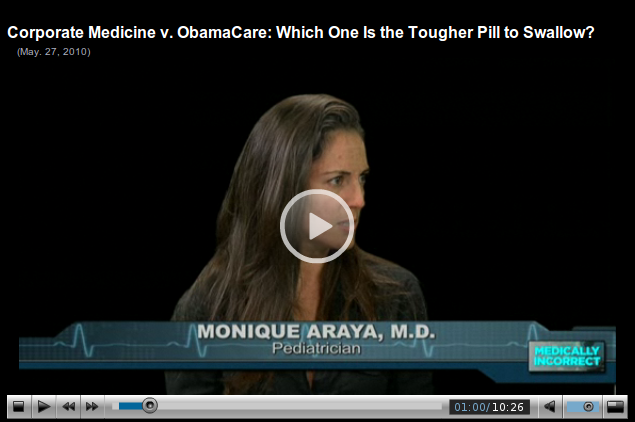
In the latest segment of PajamasTV's "Medically Incorrect", four practicing physicians discuss how government regulations interfere with their ability to practice according to their best judgment for their patients' best interests.

Click on the image below to watch "Corporate Medicine v. ObamaCare: Which One Is the Tougher Pill to Swallow?"

Medically Incorrect

The doctors discuss problems with mandatory practice standards, electronic medical records, and "one-size-fits-all" treatment algorithms.

The full video lasts 10 minutes.

(Via Ed Cline.)

Thursday, June 3, 2010

AFCM: What Health Care Reform Could Be and Ought to Be

Americans for Free Choice in Medicine has now posted video of its May 10, 2010 symposium, "Redeeming Reform: What Health Care Reform Could Be and Ought to Be".

The speakers for their joint briefing include:

Part 1
Introduction
Richard E. Ralston, Executive Director
Americans for Free Choice in Medicine

"The Constitutional Context for Health Care Reform"
Robert McNamara, Staff Attorney
Institute for Justice

"Federalism and Health Reform: Unhealthy States"
John R. Graham, Director, Health Care Studies
Pacific Research Institute

"A New Congress Will Have Opportunity to Reform, Not Deform, the Malfunctioning U.S. Health Care System"
Sue Blevins, M.P.H., M.S., Founder and President
Institute for Health Freedom
Part 2
"Morality — Not Costs — As the Proper Basis for Health Care Reform"
John David Lewis, Ph.D.
Philosophy, Politics and Economics Program, Duke University

Question Period
Part 3
"Loss of Freedom and Privacy in the Age of Corporate-State Medicine
Michael Ostrolenk, M.A., MFT, Public Policy Counsel
Association of American Physicians and Surgeons

"Selfishness at the Microscope: Your Diagnosis or Your Life"
Mark Hurt, M.D., Director
Americans for Free Choice in Medicine

"Better Access to Promising Developmental Drugs and Vaccines"
Frank Burroughs, President and Founder
Abigail Alliance for Better Access to Developmental Drugs
Part 4
"You Are Not Your Neighbor's Health Care Provider"
Yaron Brook, Ph.D., President
Ayn Rand Center for Individual Rights

Question Period
Click here to watch their talks.

Wednesday, June 2, 2010

Tuesday, June 1, 2010

Justice Dept Imposes Price Controls on Doctors

The May 31, 2010 Christian Science Monitor has published an editorial by S.M. Oliva on the federal government's latest intrusion into American medical practice -- namely price controls on physicians in Idaho.

Here's an excerpt from "Justice Department Declares War on Doctors":
Today the Antitrust Division, joined by Idaho Attorney General Lawrence Wasden, forced a a group of Boise orthopedists to accept price controls for worker's compensation and HMO contracts as part of a settlement accusing the doctors of "price fixing".

...[T]he Justice Department has unambiguously stated that refusal to accept government price controls is a form of illegal "price fixing."

The FTC has hinted at this when it said physicians must accept Medicare-based reimbursement schedules from insurance companies. But the DOJ has gone the final step and said, "Government prices are market prices," in the form of the Idaho Industrial Commission's fee schedule. The IIC administers the state’s worker compensation system and is composed of three commissioners appointed by the governor. This isn't a quasi-private or semi-private entity. It's a purely government operation.
(Read the full text of "Justice Department Declares War on Doctors".)

The DOJ's declaration that "government prices are market prices" is positively Orwellian.

When the government sets prices and refuses to allow competition, there is no market -- merely a fiat economy. (The current system of medical licensure which artificially limits supply of physicians is another violation of free market principles.)

As in any other sector of the economy, such price controls will merely lead to shortages, which in turn will result in rationing. The Idaho case is another warning to Americans.

(Via @AriArmstrong.)

Hsieh PJM Oped: Beware Dr. Galbraith's Snake Oil

The May 31, 2010 PajamasMedia has just published my latest OpEd, "Beware Dr. Galbraith's Snake Oil".

My theme is that even in the face of the Greek situation, some economists continue to argue that deficits don't matter. Here is the introduction:
As the Greek welfare state collapses, citizens there have been rioting over cutbacks in social spending necessitated by mounting government debt. The rioters apparently fail to recognize that whenever a government routinely promises to spend more money than it has, then eventually it will be unable to fulfill those promises. Many Americans worry that we will soon be facing similar troubles at either the state (e.g., California) or national levels.

Yet some renowned economists, such as Professor James Galbraith of the University of Texas, are trying to convince us that the U.S. government should ignore our massive federal budget deficit and instead spend even more. Galbraith argues that calls for fiscal responsibility are "misguided" and that greater deficit spending will create greater prosperity.

Galbraith's proposals are dangerous because they are based on the notion that you can get something for nothing. Unless we want to see a Greek-style collapse here in America, we must reject those ideas as economic "snake oil" and instead demand an end to our government’s fiscally irresponsible deficit spending.

James Galbraith is no street corner crank. Instead, he has a BA from Harvard and a Ph.D. from Yale, both in economics. He is a professor of economics at the University of Texas, Austin, and son of famous Keynesian economist John Kenneth Galbraith. Because of his impressive academic and intellectual pedigree, many Washington politicians and pundits take his ideas seriously. Hence, so must we...
(Read the full text of "Beware Dr. Galbraith's Snake Oil".)

As always, please feel free to leave supportive comments, blog about it, e-mail to friends, promote via Twitter/Facebook, etc.!