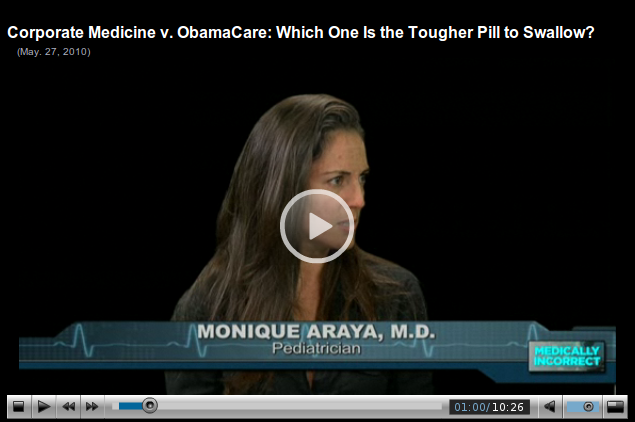
Click on the image below to watch it:

You can sign up for the D4PC e-mail list here.

The blog of Freedom and Individual Rights in Medicine (FIRM)


"We're from the government and we'll have to revoke your blogging license if you keep spreading too much 'misinformation.'"(Read the full text of "Free Speech: Use It or Lose It".)
A few years ago, such a warning would have seemed far-fetched. But recent developments threaten to turn this from bad science fiction into grim reality. If bloggers and independent journalists wish to avoid this nightmare, we must speak out now to defend freedom of speech -- and we must defend it for the right reasons...
With the full implementation of Obamacare and its likely cuts in physician reimbursement, more and more doctors will choose to opt out of Medicare and charge their patients for their care. The elderly who need specialized care will have no choice but to take out insurance, not to fill gaps in Medicare coverage, but to overlay the system with private coverage so they can get the care Medicare now provides to all seniors. If you want to see a family doctor, it will be rough unless you are paying for the care privately. And to see a specialist, at the low reimbursement rates afforded by the program in the future, will be well nigh impossible.(Read the full text of "A Health Care Horror Story From Canada".)
Medical care for the elderly will become like public housing or public education in the inner city. Those who can afford to go elsewhere will. Those who can’t will be left to fend for themselves in overcrowded public facilities that will be, at least, free.
And then, as in Canada, liberal critics will rail, not against the system that dried up the resources in the first place or against the socialist rules that drove doctors out of medicine, but against the private clinics for resources from the public sector.
By plunging our excellent medical care system into this new world of regulation, fee cuts, and care rationing, the U.S. is going down the disastrous road Canada has taken.

IntroductionPart 2
Richard E. Ralston, Executive Director
Americans for Free Choice in Medicine
"The Constitutional Context for Health Care Reform"
Robert McNamara, Staff Attorney
Institute for Justice
"Federalism and Health Reform: Unhealthy States"
John R. Graham, Director, Health Care Studies
Pacific Research Institute
"A New Congress Will Have Opportunity to Reform, Not Deform, the Malfunctioning U.S. Health Care System"
Sue Blevins, M.P.H., M.S., Founder and President
Institute for Health Freedom
"Morality — Not Costs — As the Proper Basis for Health Care Reform"Part 3
John David Lewis, Ph.D.
Philosophy, Politics and Economics Program, Duke University
Question Period
"Loss of Freedom and Privacy in the Age of Corporate-State MedicinePart 4
Michael Ostrolenk, M.A., MFT, Public Policy Counsel
Association of American Physicians and Surgeons
"Selfishness at the Microscope: Your Diagnosis or Your Life"
Mark Hurt, M.D., Director
Americans for Free Choice in Medicine
"Better Access to Promising Developmental Drugs and Vaccines"
Frank Burroughs, President and Founder
Abigail Alliance for Better Access to Developmental Drugs
"You Are Not Your Neighbor's Health Care Provider"Click here to watch their talks.
Yaron Brook, Ph.D., President
Ayn Rand Center for Individual Rights
Question Period
Today the Antitrust Division, joined by Idaho Attorney General Lawrence Wasden, forced a a group of Boise orthopedists to accept price controls for worker's compensation and HMO contracts as part of a settlement accusing the doctors of "price fixing".(Read the full text of "Justice Department Declares War on Doctors".)
...[T]he Justice Department has unambiguously stated that refusal to accept government price controls is a form of illegal "price fixing."
The FTC has hinted at this when it said physicians must accept Medicare-based reimbursement schedules from insurance companies. But the DOJ has gone the final step and said, "Government prices are market prices," in the form of the Idaho Industrial Commission's fee schedule. The IIC administers the state’s worker compensation system and is composed of three commissioners appointed by the governor. This isn't a quasi-private or semi-private entity. It's a purely government operation.
As the Greek welfare state collapses, citizens there have been rioting over cutbacks in social spending necessitated by mounting government debt. The rioters apparently fail to recognize that whenever a government routinely promises to spend more money than it has, then eventually it will be unable to fulfill those promises. Many Americans worry that we will soon be facing similar troubles at either the state (e.g., California) or national levels.(Read the full text of "Beware Dr. Galbraith's Snake Oil".)
Yet some renowned economists, such as Professor James Galbraith of the University of Texas, are trying to convince us that the U.S. government should ignore our massive federal budget deficit and instead spend even more. Galbraith argues that calls for fiscal responsibility are "misguided" and that greater deficit spending will create greater prosperity.
Galbraith's proposals are dangerous because they are based on the notion that you can get something for nothing. Unless we want to see a Greek-style collapse here in America, we must reject those ideas as economic "snake oil" and instead demand an end to our government’s fiscally irresponsible deficit spending.
James Galbraith is no street corner crank. Instead, he has a BA from Harvard and a Ph.D. from Yale, both in economics. He is a professor of economics at the University of Texas, Austin, and son of famous Keynesian economist John Kenneth Galbraith. Because of his impressive academic and intellectual pedigree, many Washington politicians and pundits take his ideas seriously. Hence, so must we...
Cass Sunstein explicitly compares Americans to Homer Simpsons requiring government guidance to live. In my view, the proper function of government is to protect individual rights and freedoms. Unless we violate others' rights by force or fraud, the government should leave us alone to live according to our best judgment.
Of course, individuals may voluntarily "nudge" themselves to achieve long-term goals, like having your bank automatically deposit a portion of each paycheck into a child's college fund. But each person must make these decisions for himself based on his goals and circumstances. These choices are his responsibility and his right -- not the government’s.
Libertarian paternalism in essence says, “Don’t worry -- we’ll do your thinking for you.” If Americans start surrendering their minds thus to the government, they will become easy prey for demagogues and dictators.
PAUL HSIEH
Sedalia, Colo.
The Massachusetts "health reform" disease means more than just bureaucrats setting prices. It also includes rising government spending and taxes; politicians demonizing doctors, hospitals and insurers -- and patients getting lectured that the restrictions of managed care are good medicine...(Read the full text of "Massachusetts health meltdown is your future".)
Government finally caring about the little guy? Hold your cheers -- because the inevitable next step is rationing at the point of consumption. Massachusetts state Senate President Therese Murray has proposed putting an end to "fee for service" medicine in the next five years and moving to a system of capitated managed care, where doctors receive a flat fee for each assigned patient.
This "HMOs for all" approach is designed to lead to soft rationing -- which, in medical terms, means people will have a hard time finding doctors or seeing the ones they have. It's already started. In Massachusetts, one doctor in two is not accepting new patients. Waits for treatment in Boston are the highest in the nation.
Berwick has decades of experience in health policy and, on paper, would seem a perfect candidate for the job. But he has fallen into the trap of many intellectual elites, which we might call the Harvard Disease: assuming that a government committee can guide one-sixth of the national economy into efficiency.(Read the full text.)
In many ways, the Harvard professor represents all that is wrong with the Obama White House’s approach to health-care reform. As an unabashed admirer of Britain’s National Health Service, he sees only one solution: a 10-point plan, with more micromanagement by clever elites...
Many doctors worry that promised savings to their practices will not materialize. And there are plenty of examples of frustration with computers on the front lines.(Read the full text of "Doctors not in stampede to go digital".)
"If this is a cost saver, I don't get it," says Dr. Michael Cohen, 49, a nephrologist in Wakefield who uses electronic records.
Cohen often can't send crucial patient information to other physicians because their systems are incompatible. He finds that the records contain so much data that important information can be buried. Mistakes in the records, he said, can be hard to detect and change.
"I agree that a good working system can be an incredibly powerful tool, but there's an incredibly steep learning curve," said Cohen.
The truth is the public option is alive and well, residing in Section 1334, pages 97-100, of the new health care law. That section gives the U.S. Office of Personnel Management -- which presently manages the federal civil service -- new responsibilities: establishing and running two entirely new government health insurance programs to compete directly with private insurance companies in every state with coverage for people outside of government.(Read the full text of "Public option is alive and well, but hidden".)
Quoting the new law, former OPM director Donald Devine notes that it makes the OPM boss a health care czar, with power to set "'profit margin premiums and other such terms and conditions of coverage as are in the interest of enrollees in such plans.' That's open-ended. You can do anything." Dan Blair, another former OPM director, calls the new program "nothing but a placeholder for the public option." Indeed, the OPM head is also given the authority to "appoint as many employees" as needed to run the program, and to spend "such sums as may be necessary" to establish and administer it.
Agents and brokers are on the front lines of navigating between health insurers, business owners, patients and health professionals, and the value they bring to the health sector is highly under-appreciated. Most of their clients are small and medium-sized businesses, and the agents basically serve as external human resources departments for them. They work hard to find policies to meet companies' needs (and budgets), hold seminars to brief employees on the benefit plans, and serve as intermediaries to make sure claims are paid and even help employees find physicians and the best hospitals.So when your employer stops offering health insurance because ObamaCare rules make it too expensive, and you're forced to fend for yourself in system of government-run "exchanges", will you be able to trust that your Obamacare "navigator" is really working for your best interests, rather than in the interests of his government paymasters?
The new health law indirectly acknowledges the value of agents by creating a new profession called "Navigators" for the new state health exchanges. But they won't be paid through the commissions that agents earn today. Instead, the Navigators will get government "grants" to help people select policies. The Navigators will, of course, more likely be beholden to politicians for their jobs than their clients. And once someone has a problem with a claim, good luck in getting them to help.
In early 2009, health insurance companies struck a Faustian bargain with the Obama administration. In exchange for a law requiring Americans to purchase health insurance, they agreed to regulations requiring them to offer coverage to all comers regardless of preexisting illnesses. Now that ObamaCare is law, insurers are learning that they may have sold their souls to the Devil -- along with the lives of the American people.(Read the full text of "The Health Insurers' Faustian Bargain".)
At first glance, ObamaCare might seem a good deal for insurance companies by guaranteeing them a market for their services. But this guaranteed market comes at a steep price, with the government dictating whom insurers must cover, what benefits they must offer, and what prices they may charge...
Some of the stuff we do have to fund, because the agencies are going to have to have staff to deal with the new requirements; and the stuff we don't have to fund is the demonstration projects that I was assured were going to bend the cost curve. So if we save this money in the first ten years, we lose the possibility of lower cost growth after the first decade.I suspect we'll be in for more unhappy surprises in the near future.
What's really worrisome, however, is that I'm unaware of any happy surprises where it turns out this thing is going to cost less than expected.
In the group setting, the patients are not allowed to remove clothing for proper physical examination due to the lack of privacy. In the video, Dr. Lindsey is shown auscultating and percussing through the patients' clothing.Moreover, while the concept of a "medical home" sounds nice in theory, it can also be easily corrupted to become just another vehicle for rationing.
As a medical student, I would flunk, that's right, flunk my standardized patient examinations if I even thought of auscultating or percussing through clothing. It is obvious that the lack of privacy even in the cardiology setting restricts the doctor from doing a proper physical examination.
[Under ObamaCare,] Americans buying through the exchanges -- and as we've seen, that will soon be most Americans -- must get their care through something called "medical home." Medical home is similar to an HMO. You're assigned a primary care doctor, and the doctor controls your access to specialists. The primary care physicians will decide which services, like MRIs and other diagnostic scans, are best for you, and will decide when you really need to see a cardiologists or orthopedists.Under the new "medical home" concept, the task of denying care is shifted from the government to the primary care physician (who may be operating under hidden government financial incentives to reduce referrals and control costs). As we've seen in countries like Great Britain, this pits the physician's interests directly again his patients' interests.
Under the proposals, the gatekeepers would theoretically guide patients to tests and treatments that have proved most cost-effective. The danger is that doctors will be financially rewarded for denying care, as were HMO physicians more than a decade ago. It was consumer outrage over despotic gatekeepers that made the HMOs so unpopular, and killed what was billed as the solution to America's health-care cost explosion.
"You oppose Medicaid and government-run schools? You're heartless and lack compassion." If you have ever made this accusation, even tacitly, I invite you to reconsider the government policies you support.(Read the full text of "Questioning Your 'Compassionate' Politics".)
Why does being compassionate mean supporting government-run schools and health plans? This makes little sense if you view these programs as government-run charities. Would you agree to perpetually donate a portion of your monthly income to the same charity - regardless of its effectiveness? If the charity is doing a lousy job, wouldn't you want the freedom to find a better one?...
Your wife is stricken with a terrible medical condition. Her insurance benefits just ran out. You need money for her treatment.(Read the full text of "A Health Care Parable".)
You go to your next-door neighbor and tell him about your wife's misfortune. You demand $5,000.
Your neighbor is stupefied. Still, he expresses sympathy for your situation. He refers you to a registered charity and offers to connect you with someone who could help start a campaign to raise donations for your wife. He gives you a check for $100.
Your frustration mounts. Your emotional state is the equivalent of that which one feels from the recognition of a moral injustice, as if nature has the ability to inflict illness upon your wife by a conscious, concerted intent to rob her of her life.
Although your reason tells you no one is to blame, you let your mind obsess on the fact that your neighbor earns a lot more money than you or your wife. You rationalize that he really ought to give you more than $100, in the name of fairness, equality, social justice.
Indeed, you have gleaned through cultural sensibilities that, by right, you have some claim on the time, money, goods or services of others. Moreover, you hold that those who have should give to those who have not, as a matter of moral duty. You feel justified -- even righteous -- in compelling others to act in accordance with moral truth as you see it.
So you point a gun at your neighbor and demand more money. While you are uneasy about this, you repeat to yourself that you have the moral high ground; that, in the grand scheme of things, you are doing the right thing -- and so, too, will your neighbor, if he acquiesces.
Your neighbor begs you to understand that you have no right to initiate force against him. You grant this, for now, and put the gun away. But you have another plan.
You organize a local town hall meeting and invite your Congressman...
The AMA was not only a major supporter of ObamaCare but also an accomplice in its passage. Without the support of the AMA it is quite possible that the health-care reform initiative would have failed. So why the effort to silence other doctors? The AMA is not only worried about protecting this misguided legislation, it is worried about protecting itself.Specificially, Schertz argues:
...The irony is that in supporting ObamaCare and trying to silence doctors the AMA has forgotten its own mission statement and ethical code: "[T]o help doctors help patients by uniting physicians nationwide to work on the most important professional and public health issues." It is always medically ethical to tell patients the truth, which is what doctors are now doing by educating them about ObamaCare.
1) The AMA is attempting to inappropriately silence doctors speaking out to patients and the public against ObamaCare.(Read the full text of "Why the AMA Wants to Muzzle Your Doctor".)
2) The AMA only represents 17% of physicians.
3) The AMA's political positions are not necessarily driven by any high-minded concern for patient welfare, but may be inappropriately influenced by a desire to retain special government-granted monopoly privileges over medical coding and billing standards, which can be quite lucrative for the organization.
...Another thing that struck me about the movie is how much it reinforced my existing political views about modern American medicine and health insurance. One person interviewed for the film claimed that often a C-section surgery is a legal strategy. The idea is that, if a doctor performs a C-section, he or she has made every possible medical intervention, and so cannot be sued. So the problems with American torts certainly show in this area.(Read the full text of his blog post.)
I have long argued that third-party insurance payments -- entrenched by decades of federal tax policy and controls -- subvert individual responsibility. One women in the film said, "People in our culture spend more time and effort researching to buy a stereo system, a car, probably a camera, than they do checking out what their choices are for birth." In our third-party system of prepaid health care, most people have no incentive to seek out good value for their health dollars. Moreover, most people get the health care their employer's insurance company tells them to get, rather than the health care that would best serve their needs.
My wife and I, on the other hand, buy low-cost, high-deductible health insurance and pay for routine and expected care through our Health Savings Account. We're going to pay for our delivery by writing a check or running the debit card. We know what care we're getting and how much it costs. It is only if something goes terribly wrong, resulting in higher bills, that our insurance would kick in. ...
As fewer and fewer young doctors go into internal medicine and family practice, and thousands of primary care doctors retire early due to financial pressures, the primary care shortage will only worsen. Not only will there be no primary internists to take care of their own patients in the hospital, there will be fewer internists available to see patients in the office setting. This inevitable vacuum of internists and family practitioners (traditional diagnosticians) will be filled by nurse practitioners and medical assistants; people with far less training and expertise than an M.D..I do believe that patients and providers should be able to contract freely for medical services, and this includes so-called "mid-level providers" such as nurse practitioners. But Dr. Knope makes an important point -- namely,that you may not get the same level of care with a mid-level provider than with a MD.
If you are fortunate enough to have a good nurse practitioner, you will eventually be referred to an appropriate specialist, who will treat one of your medical problems. If you are not so lucky, a nurse or medical assistant may miss an uncommon or rare diagnosis; he or she may misdiagnose the "headache" that is actually an aneurysm, the "flu symptoms" that turn out to be meningitis, or the "gallbladder problem" that turns out to be a heart attack. Bad things will inevitably happen when doctors are replaced by medical assistants. It is simply a matter of statistics. All doctors make mistakes, but those with less training make more.
As a concierge physician, people often ask me how this move toward a government-run healthcare system will affect me professionally. Speaking honestly, I tell them that it will help my practice, but I do not think this is good news for the country. As an independent concierge doctor, I am not subject to the rules or fees set by Medicare or Medicaid, nor do I deal with third-party insurance carriers or HMOs. I work for my patients, not a third-party with a conflicting financial agenda. As someone who practices full-service internal medicine, the demand for my services will continue to increase.
However, this outlook about my own practice does not make me happy. I have small children. I am concerned about their future. I am concerned about what the changes in primary care will do the future of American medicine; what will happen if the art of internal medicine is completely lost. I am worried about what it will mean to the efficiency of medicine as a whole, to have no diagnosticians and clinicians to treat the majority of problems that do not need a specialist.
When many of the real ObamaCare changes finally do take hold beginning in 2013, my patients will find that the world of their medical care will get even worse, not better. Hospital ERs will be even more crowded with the newly insured. Doctors' offices will be swamped.(Read the full text of "ObamaCare: Now What?")
Beginning in 2013 16 million more people will be eligible for Medicaid, but where will they go for care? I don't accept Medicaid now, because it doesn't pay my office expenses, and I won't accept it then, even if the reimbursements increase slightly for two years. Without a network of specialists to refer Medicaid patients to (specialists fees will not be increased), I won't be able to work with it any more in 2013 than I am now.
In 2014 patients with pre-existing conditions will be able to obtain insurance no matter whether they are working, healthy, or sick. Many will qualify for federal subsidies. But where will this group go for care? My office practice is already full. And I must admit that once the health reform bill takes hold in a few years, if I do have an opening in my overburdened schedule I will be more inclined to see a patient with a single problem rather than a complex patient. Insurance may cover those with multiple pre-existing conditions but this doesn't mean I will be able to take care of them.
The first challenge is that comparative effectiveness research, by necessity, focuses on broad populations of patients. But as [Duke University researcher Amy] Abernethy pointed out, "in oncology, we take care of individuals." Newly prioritized research might turn out new results about treatments that are best for most breast cancer patients with a defective HER2 protein, for example, but many other individuals with different genetic factors might still need trial-and-error treatment until research finds what works best for them.Government "guaranteed" health care will accelerate this push where collectivist treatment guidelines and goals are favored over benefitting the individual.
Traditionally, medicine is practiced by physicians, one patient at a time. The outcome is assessed by that patient. The right decision is the one chosen by the patient, in consultation with the physician, based on what is optimum for that patient, considering all aspects of his circumstances. The standard of care is the Oath of Hippocrates: providing treatment for the good of each patient according to the best of the doctor's ability and judgment.One indicator that ObamaCare will be running into fiscal trouble will be calls by government officials and pundits for further "sacrifices" by patients for the sake of the collective. And for some reason, the sacrificial victim will always be you! Funny how that works...
In the "reformed" delivery system, healthcare is practiced from on high by committees of "experts" pulling the strings of marionette physicians (rankings, payment rates, other incentives and disincentives) who are judged on how well they achieve population-based outcomes. Patients are like sheep in the flock, categorized by race, income level, quality-adjusted remaining years (QARYs), compliance, functional ability, diversity score, or whatever metrics the rulers adopt. Any individual can be sacrificed for the good of the whole.
Suppose our government declared that everyone had the “right” to a nice steak dinner. The government would require restaurants to sell $50 steak dinners to all comers. But to keep prices affordable, restaurants could only charge $25. No restaurant could survive long under such a scheme, and most Americans would be outraged at such a blatant violation of restaurant owners’ rights.(Read the full text of "ObamaCare: Insurers Need Permission to Survive; Citizens, to Live".)
But that is exactly what is happening with health insurance in Massachusetts. Events unfolding now in the Bay State should serve as a warning to the rest of America of the danger ObamaCare poses to our health insurance, our health care — and ultimately our lives.
"Tuesday, April 27: Debate on ObamaCare lawsuit, CU-Boulder"
"The 'choice' to prohibit other people's choices"
"Health information technology: benefits and problems"
New York's insurance system has been a working laboratory for the core provision of the new federal health care law -- insurance even for those who are already sick and facing huge medical bills -- and an expensive lesson in unplanned consequences. Premiums for individual and small group policies have risen so high that state officials and patients' advocates say that New York's extensive insurance safety net for people like Ms. Welles is falling apart.The spiral of controls causing problems leading to calls for more controls is clear:
In 1993, motivated by stories of suffering AIDS patients, the state became one of the first to require insurers to extend individual or small group coverage to anyone with pre-existing illnesses.ObamaCare seeks to avoid this problem by the individual mandate, requiring people to purchase insurance (as in Massachusetts). The result:
New York also became one of the few states that require insurers within each region of the state to charge the same rates for the same benefits, regardless of whether people are old or young, male or female, smokers or nonsmokers, high risk or low risk.
Healthy people, in effect, began to subsidize people who needed more health care. The healthier customers soon discovered that the high premiums were not worth it and dropped out of the plans.
But analysts say that provision could prove meaningless if the government does not vigorously enforce the penalties, as insurance companies fear, or if too many people decide it is cheaper to pay the penalty and opt out.Unfortunately, the insurance industry lobby has argued for stricter penalites rather than free market reforms -- i.e., further infringements on individual freedoms. Unless they take a principled stand for freedom, they'll just be aiding in their own eventual destruction through this increasing spiral of regulations -- and taking the rest of us down with them.
Jack Cassell is too much for some people.(Read the full text of "A Prescription Against Tyranny".)
He's the Florida doctor who told his patients to go elsewhere for treatment if they voted for President Obama. The message posted on his office door: "If you voted for Obama ... seek urological care elsewhere. Changes to your health begin right now, not in four years."
...Cassell told Fox News that the real purpose of his door posting was educational, not racist, and that he wasn't literally turning down patients.
"I came across the timeline for implementation of ObamaCare and I got a little discouraged when I got to next year and found that most of the ancillary services and nursing homes and diagnostic imaging, all these things start to fade away, and I felt that my patients really need to know about this, and the more I thought about it, the angrier I got until I finally felt like I'm going to put a little splash page on my front door and just get people thinking a little bit," Cassell explained.
"I think there's a real, real problem that's going on here in this country and unfortunately ObamaCare fatally compromises my ability, or any doctor's ability, to uphold the Hippocratic Oath," he continued. "I mean, I can't believe that more people aren't standing up. I think all the doctors in the United States need to take a stand on this, because pretty soon it's going to be too late."
In a new report, the Congressional Research Service says the law may have significant unintended consequences for the "personal health insurance coverage" of senators, representatives and their staff members.(Read the full text of "Baffled by Health Plan? So Are Some Lawmakers".)
For example, it says, the law may "remove members of Congress and Congressional staff" from their current coverage, in the Federal Employees Health Benefits Program, before any alternatives are available.
The confusion raises the inevitable question: If they did not know exactly what they were doing to themselves, did lawmakers who wrote and passed the bill fully grasp the details of how it would influence the lives of other Americans?
Instead of our elected Representatives in Congress giving us answers, they regurgitated talking points (if they could be bothered to address us at all). Instead of thoughtful, needed health care reform, they arrogantly forced upon us the largest expansion of government power and largest intrusion into our lives that our nation has ever seen.(Read the full text of "Dennis Moore must be recalled")
...Mr. Moore, you refused to read the bill before foisting it upon us. You swore to us that health care rationing was not in it. When you were asked to discuss specific provisions in the bill, you said no. Your actions are worse than dishonest. They represent a dereliction of duty. You refused to perform the most basic function of your office: to read a bill before voting for it.
As a result of your dereliction, patients will suffer and lives will be lost. Because of your reckless abandonment of your duty to Kansans, families will be shattered. Your profound arrogance and cavalier disregard for the needs of your constituents make you dangerous. It's sad but true: You have not faithfully discharged your sworn duties as a United States congressional representative.
Every life-threatening disease presents a health emergency to the individual patient. Morally, you have the right to seek the best treatment you can find. Yet our legal system denies you that right when it comes to private health emergencies.I'm glad to see more discussion of health care issues from the ARC, and I hope their works receive the attention they deserve.
Despite enactment of the Democratic health law, one reform Republicans and market advocates should fight to keep alive is the Health Savings Account (HSA), which allows people to put pre-tax money into an account dedicated to health-related expenses.(Read the rest of "Keep Pushing For Health Savings Accounts".)
Experiences my wife and I have had this week illustrate the power of paying for one's own health care, which an HSA encourages. Rather than pay a hundred plus dollars each to a doctor and an out-of-state testing facility, we each paid King Soopers $20 to test our blood cholesterol. I'm not saying this is a good substitute for seeing a doctor, but we wanted to get a test between regular doctor visits. Our actions illustrate the fallacy of claims that self-payers don't get preventive treatment. We are highly committed to doing what we can to prevent long-term health problems by taking care of ourselves and paying for preventive care.
The Deadly Tax on Medical Innovation(Read the full text of "The Deadly Tax on Medical Innovation".)
Most technology aficionados are familiar with Moore's Law, which states that computing power tends to double roughly every two years. The average American experiences this most clearly when purchasing personal computers. In 1998, Apple introduced its iMac computer with a 233 MHz processor, 32 MB RAM, and 4 GB hard drive, for a price of $1300. In 2010, Apple's low-end iMac includes a 3.06 GHz processor, 4 GB RAM, and a 500 GB hard drive for $1200. This represents a greater than 10-fold increase in processor speed and over 100-fold increases in RAM and hard drive sizes for roughly the same nominal dollar amount (30% fewer real dollars after adjusting for inflation).
Similar but more quiet progress has also occurred with medical technology. During my medical career, MRI scanners have advanced from creating crude but workable images of brain tumors to generating high-resolution scans displaying not just their anatomic extent, but also their internal chemical composition and the extent of functional disruption caused to the rest of the brain architecture. These advances allow doctors to plan surgery and radiation treatments in an extremely precise fashion to remove the tumor while preserving as much normal brain function as possible. As Clayton Cramer has observed, modern American medicine is much closer to the Star Trek "Sickbay" than doctors could have imagined a mere 20 years ago.
Raymond Kurzweil has generalized Moore's Law as "The Law of Accelerating Returns," arguing that technological progress overall follows a roughly exponential curve. This exponential curve is a natural reflection of the fact that today's progress forms the base of tomorrow's innovation. This create a virtuous cycle in which innovators continually build on each other's work, adding to an ever-increasing fund of knowledge, which in turn allows for future innovations. When people are left free to innovate, the exponential gains they create are therefore akin to the exponential growth we see in our bank balances when we allow compound interest to operate over time.
However, such exponential gains are not automatic. Moore's Law (and Kurzweil's generalization) are not laws of nature. Instead, they presuppose a system of government that leaves innovators free to create. Conversely, a government that penalizes innovation could dramatically slow the pace of medical progress, leading to millions of preventable deaths. And this may be one of the worst long-range consequences of the recently passed ObamaCare health legislation...


Obamacare supporters then: Talk of rationing talk is just paranoia from "death panel" types.
Obamacare supporters now: "Saying no" to medical care will be most important task of those who implement the new health care system.
1. The new law will increase the federal budget deficit.But I wanted to highlight his 5th point with an extended excerpt:
2. The new law will reduce jobs in private industry.
3. The new law will increase government jobs.
4. The new law will hurt health care for those with critical needs.
5. The new law will reduce American innovation.(Read the full text of "Five Hidden Costs of Health Care: What the Government Doesn't Want You to Know".)
The new law will reduce innovation in several ways. First, specific taxes on innovative medical devices and new costs for drug companies mean a special tax on innovation. New taxes will be added to the overall cost of treatment and innovation thus will be discouraged.
Second, innovative medical treatments will be discouraged in America. Articles by American doctors dominate almost every medical journal in the world. Today's system encourages breakthroughs and creativity. Yet the new health law encourages cookie-cutter treatments and punishes deviation from treatment norms thereby discouraging innovation.
Third, the bill imposes several new taxes on investment. This means less money will go to new businesses and taking risks. The result will be less money for research, development and innovation.
If you dislike your health insurer now, get ready for insurers' response to insurance price controls. The recently passed HR 3590 will impose them nationally, and some politicians in Colorado want more. Insurance price controls will make your insurer act like a slumlord. Expect worse customer service, skimpier plans, and more claim denials.(Read the full text of "Get ready for health insurance slumlords".)
Price controls on rental properties encourage landlords to become slumlords. Forbidden from making a profit by renting at market rates, to make a living landlords must skimp on quality and service, rather than please customers. The same will result from insurance price controls: lousy policies for people with pre-existing conditions or anyone who might get sick. That is, everyone...
Thousands of consumers are gaming Massachusetts’ 2006 health insurance law by buying insurance when they need to cover pricey medical care, such as fertility treatments and knee surgery, and then swiftly dropping coverage, a practice that insurance executives say is driving up costs for other people and small businesses.(Read the full text of "Short-term customers boosting health costs".)

Health Care 'Disaster'The fight continues.
You are right that the collapse of TennCare ("The TennCare lesson: A natural disaster," March 27 and TribLIVE.com) was an ominous indicator of what will now happen across the U.S. A more recent example is Massachusetts, where mandated health insurance has become the most expensive insurance in the U.S.
Federal mandates and new coverage requirements on top of state regulations will result in a new "race to the top" of rapidly escalating insurance premiums caused by this government action -- while Medicare and Medicaid costs continue to spin out of control. Then a nonexistent "free market" will get the blame and justify an even heavier government hand.
Richard E. Ralston
The writer is executive director of Americans for Free Choice in Medicine in Newport Beach, Calif.
