Monday, November 30, 2015

Hsieh Forbes Column: Why You Want Your Doctor To Be Wrong (Sometimes)

My latest Forbes piece is now out, "Why You Want Your Doctor To Be Wrong (Sometimes)".

Here is the opening:
“Mommy, my tummy really hurts!”

Your 7-year old daughter wakes you up in the middle of the night, doubled over in pain. You take her to the local ER. The on-call surgeon, Dr. Smith, performs a thorough physical exam, reviews the test results, informs you that she has appendicitis, and says she needs surgery right away. You sign the consent forms, and he whisks her off to the OR. An hour later, Dr. Smith comes back and says, “I’m sorry. We removed her appendix, but it turned out to be normal. She didn’t have appendicitis, just a severe case of gastroenteritis or ‘stomach flu’.”

Should you be relieved or angry? Did Dr. Smith make a mistake? Did he perform an unnecessary operation?...
I discuss Type 1 vs. Type 2 errors, why they are important, and why certain kinds of diagnostic errors are not merely unavoidable but (in the right context) desirable.

For more details, read the full text of "Why You Want Your Doctor To Be Wrong (Sometimes)".

And my personal favorite example of Type 1 vs. Type 2 errors is below:


Thursday, November 19, 2015

When Unethical Medical Experiments Bear Fruit

I'm not a utilitarian, and the medical experiments described below were truly appalling.

But there is some informative medical history in this piece: "These medical experiments were horrible, unethical — and useful".

People can debate some of the fine points of the current system of IRB (Institutional Review Board) approval and informed consent for medical experiments.  But the current system is far better than what has occurred in the past.


Tuesday, November 17, 2015

Short Story: SMOD 2016

I'm exercising blogger's privilege to post something totally unrelated to health care policy.

Here's my latest short story, "SMOD 2016" (400 words).   FYI, it's a little dark, in the spirit of Frederic Brown.

Here is the opening:
SMOD 2016
A short story by Paul Hsieh

"So, basically you're saying that humanity should be extinct by now." MIT astrophysics professor Linda Tsang furrowed her brow.

"Yes, many times over," replied statistics professor Max Wendt. "Based on the new telescope data you provided me about the asteroid belt, the Earth should have been struck by a 'Dinosaur Killer' rock at least 5 or 6 times in the past 10,000 years."

"So, why haven't we?" asked Tsang.

"Well, there are a few possibilities," said Wendt...

Read the rest at: "SMOD 2016".

["Asteroid Belt", image courtesy Wikipedia.]

Monday, November 16, 2015

The Inadequacy of 15-Minute Medicine

In the Washington Post, Dr. Michael Stein writes: "When medical care is delivered in 15-minute doses, there's not much time for caring".

Dr. Stein's bottom line:
My job, in its barest 15-minute form, is to separate the serious possibilities from the less serious, offer a diagnosis and an explanation, recommend any additional testing and list the possible courses of action. But a hurried, task-oriented approach doesn’t accommodate the meandering, overlapping, widening issues of patients. It undermines kindness. And it prevents doctors from being what our patients hope we will be when they walk in: unrushed explorers on the lookout for the next discovery.
Fortunately, patients and doctors can avoid these problems through a "direct pay" or "concierge" model, as discussed in my earlier Forbes piece, "Is Concierge Medicine The Correct Choice For You?".  Doctors can take the time to give the patients' issues the attention they need.

One excerpt:
In response to this frustrating situation, more doctors are seeking an alternative practice model. They are establishing “concierge” or “direct pay” practices, where patients pay a monthly or annual fee for enhanced services, including same day appointments, 24/7 access to their doctor, e-mail consultations, and longer appointment times. Instead of the usual rushed 10-15 minute appointments, these doctors typically offer 45-60 minute visits allowing them to really delve into their patients’ problems and craft individualized treatment and prevention plans.

The Indianapolis Business Journal described how concierge medicine helped patient Dale Sventeck. Sventeck suffered from a “frozen shoulder” which severely limited his range of motion. Most doctors he saw simply wanted to schedule him for an MRI study and surgery. But concierge physician Kevin Logan was able to take the time to diagnose that Sventeck’s problem was caused by the mercury in his dental fillings. Dr. Logan advised Sventeck to remove the fillings. One month later, his shoulder was back to normal.
(Washington Post link via Dr. Matthew Bowdish.)

Thursday, November 5, 2015

Sissel Lawsuit Update

Matt Sissel has an OpEd in the 11/3/2015 Washington Times on his anti-Obamacare lawsuit: "Taking a stand against Obamacare".

Sissel is being represented by Timothy Sandefur of the Pacific Legal Foundation (PLF).   For more details, see the PLF page on the case.

I wish them both success in their fight for individual rights!

Monday, November 2, 2015

NEJM On Peer Review Fraud

New England Journal of Medicine: "Peer-Review Fraud -- Hacking the Scientific Publication Process".

Fraudulent reviews on Amazon or Yelp are bad enough. Fraudulent peer review in science and medicine could be very, very dangerous to patients.

Wednesday, October 28, 2015

Washington Post Vs. Paternalistic Breast Cancer Guidelines

Washington Post editor Marisa Bellack speaks out against paternalistic mammography guidelines in her editorial, "Don't worry your pretty little head about breast cancer".

She notes that "anxiety" is being increasingly invoked as a (bad) reason to limit screening mammography, especially for women between ages 40-49:
And yet, there was a 19th-century echo in the American Cancer Society’s announcement this past week of revised guidelines for breast cancer screening. Whereas anxiety was once a reason for aggressive medical intervention, it is now invoked to avoid intervention — an argument that is both patronizing and unscientific. There may be good reasons for women in their early 40s to forgo regular mammograms, but this isn’t one of them.

A reference to anxiety appears in the very first paragraph of the harms-and-benefits analysis commissioned by the cancer society: While early screening “reduces breast cancer mortality, there are a number of potential harms, including false-positive results, which result in both unnecessary biopsies and increased distress and anxiety related to a possible diagnosis of cancer.”

But the idea that anxiety is a major harm doesn’t have much scientific support...

There will always be uncertainty in cancer screening. And that uncertainty understandably fuels anxiety. But most false-positive mammograms are quickly resolved by additional imaging. Among the cases that progress to biopsies, 9 out of 10 show no sign of cancer. And even when there is a breast cancer diagnosis, that’s not equivalent to a death sentence. Doctors should be able to respond to anxiety rationally, putting fears in context and expediting follow-up testing and results to limit what can be an agonizing wait.
For more details, read the full text of "Don't worry your pretty little head about breast cancer".

See also this related Washington Post piece, "Why this Harvard radiologist still recommends women get mammograms at age 40".

(Link via Dr. Evan Madianos.)

Monday, October 26, 2015

Hsieh Forbes Column On Doctor 'Report Cards' And Unintended Consequences

My latest Forbes piece is now out, "Doctor 'Report Cards' May Be Hazardous To Your Health".

I discuss the rise of physician "report cards" for heart surgeons and other advanced surgical specialties, as well as some of the unintended consequences these report cards can create for patients.

One take home point from my piece:
The report cards can tell you how many patients died under a particular surgeon’s care. But they can’t tell you how many of those patients would have died without surgery. And more importantly, the report cards can’t tell you how many of those same patients would have died if treated by a different surgeon — because each surgeon gets to choose which patients he or she will operate on.

The goal of recognizing good doctors is laudable. But the proposed “report cards” have serious limitations. Patients looking for a good surgeon should consider these report cards as merely one data point among many — and not necessarily the most reliable.
I also cover other ways patients can find a good surgeon, in addition to these "report cards".

Various private rating systems will be a mixed bag, each with their own strengths and flaws. I personally think all such ratings will have flaws that patients need to know about, which is one point of my article. Fortunately, patients can listen to (or ignore) those ratings as long as they remain private.

In contrast, government rating system will be very easily captured by those with agendas that don't necessarily align with patient interests (such as cost containment), and that's where we can potentially see big trouble.


For more details, read the full text of "Doctor 'Report Cards' May Be Hazardous To Your Health".

I also recommend a related article by Dr. Saurabh "Harry" Jha, "When a bad surgeon is the one you want: ProPublica introduces a paradox".


Sunday, October 25, 2015

Saturday, October 24, 2015

Ebola Quarantine Lawsuit

Doug Mataconis discusses: "Nurse Kaci Hickcox Sues Chris Christie For Civil Liberties Violations During Ebola Quarantine". 

This is some legal fallout from last year's big Ebola scare, in which many people were calling for restrictions on people coming to the US from affected areas in Africa.

From Mataconis' blog post:
[Kaci Hickcox] was detained at Newark Airport after arriving home from West Africa and not allowed to continue on to her connecting flight. Instead, she was taken into custody and detained in a tent outside a hospital in Newark, New Jersey before being allowed to return home to Maine.

Once in Maine, that state’s Republican Governor Paul LePage, who just happened to be running for re-election, attempted to impose severe restrictions on Hickox’s liberty notwithstanding the fact that she displayed absolutely no symptoms of having the Ebola virus and that asymptomatic patients are not contagious.

Governor LePage’s efforts were derailed by a Maine State Court Judge, who limited the requirements placed on Hickox to keeping local health authorities informed of her condition and location during the incubation period for the disease.

Now, Hickcox has filed a lawsuit alleging that Christie and other government authorities violated her civil liberties...
I fully agree with the principle that the government has the legitimate authority to quarantine people who carry a deadly infectious disease -- or who pose an objective threat of such -- based on best reasonable medical knowledge.

The key issue in this case is whether someone who displayed no symptoms and was supposedly not at risk of transmitting the disease to others posed such an "objective threat". 


Friday, October 23, 2015

In Defense Of Old Mammography Guidelines

In response to new mammography guidelines from the American Cancer Society, the Washington Post covered the controversy in their 10/20/2015 piece: "Why this Harvard radiologist still recommends women get mammograms at age 40".

They interviewed Dr. Daniel Kopans, professor of radiology at Harvard Medical School and a radiologist at Massachusetts General Hospital.  Dr. Kopans discussed why age 40 should be retained as a better threshold than 50 for screening, as well as issues of overdiagnosis and insurance coverage.

Read the full text for more information.

Wednesday, October 21, 2015

The Flip Side of Shopping Solely By Price

Health care reporter Sarah Kliff decided to go with the least expensive MRI scan to check for a stress fracture in her foot.

Her conclusion: "I didn't think I was making any trade-off when I chose a cheaper MRI. Now I know that isn't true."

(See earlier piece, "NPR: Pay Patients, Save Money".)

Monday, October 19, 2015

Get Out of Obamacare

The Atlantic lists "All the Ways to Get Out of Obamacare".

Lots of government fine print.  (Via Dr. Megan  Edison.)

Wednesday, October 14, 2015

NPR: Pay Patients, Save Money

NPR's Planet Money podcast discusses a novel program to help patients save money on health care by cutting them in for a piece of the savings: "Pay Patients, Save Money".

Although not a fully market-based mechanism, it does show that patients can respond to incentive when they have "skin in the game".

For similar reasons, I support Health Savings Accounts and other market-oriented mechanisms to give patients more flexibility and control over their health spending.


Wednesday, September 30, 2015

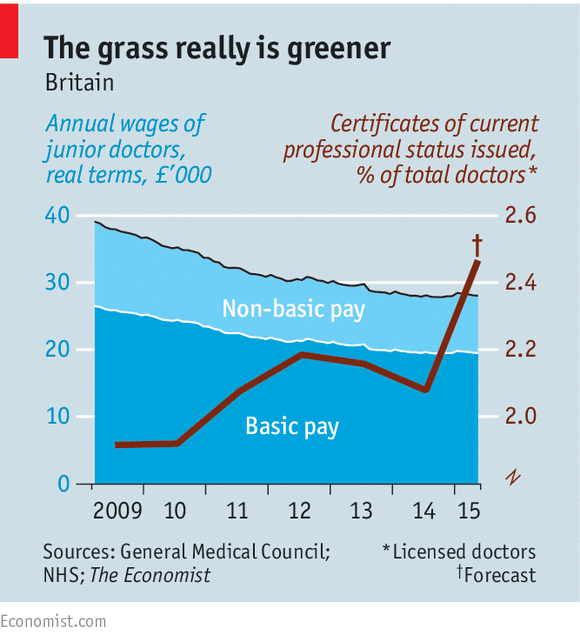
Doctors Leaving The UK

The Economist discusses the growing problem of unhappy UK physicians, "Some junior doctors consider a strike, while others pack their bags".

One possible "canary in the coal mine" indicator:
Like workers in any public service, doctors always say that morale has never been lower. But this time many are threatening to vote with their feet and practise overseas. Normally the General Medical Council, which regulates the profession, gets 20-25 requests a day for certificates of professional status, which make it easier to work abroad. From September 16th-18th it received a staggering 1,644 requests.


Monday, September 28, 2015

Hsieh Forbes Column on Bad Science Reporting

My latest Forbes piece is now out: "How To Protect Yourself Against Bad Science Reporting".

I discuss some sources of error and bias that lead to bad science reporting, including:
1) Many publicly reported science results are still provisional
2) Beware of sloppy statistics
3) Beware of the bias towards positive dramatic results
This latest piece is relatively non-political. But it is uncompromisingly pro-bacon.

For more details, read the full text of "How To Protect Yourself Against Bad Science Reporting".


Thursday, September 24, 2015

Preventing Medical Errors

Medical errors will happen. As Arlene Weintraub notes in Forbes, "Doctors Are Screwing Up Diagnoses -- And Patients Should Speak Out".

An excerpt:
The authors of the IOM report identify several possible methods for encouraging patients to get more involved in their diagnoses. First, they suggest that the act of diagnosis should no longer be treated as a solitary task that takes place mostly inside a single clinician’s brain—but rather as a team effort that includes patients and their families. To achieve that, the authors admit, the entire culture of the healthcare system needs to change to one that welcomes patient feedback...
I personally think that patient should obtain their own personal copies any important medical records (including radiology studies on CT, pathology reports, etc.) in case they wish to review them at home or in consultation with an independent physician.

And overall, patients should treat physicians as advisors -- but not infallible authorities.

Tuesday, September 22, 2015

Adalja on Pyrimethamine and The Market

Dr. Amesh Adalja discusses "Pyrimethamine and the Market".  An excerpt:
While I have no understanding of how the new price was determined, it will eventually have to withstand the scrutiny of the market. If the price is set higher than the market will bear, because it is no longer under patent, other manufacturers will enter the market lowering prices. Ideally this would happen near instantaneously but, because of legislative barriers to entry, which include a multi-step approval process, it will take some time. Better alternatives to the current regimen may also appear in time as well.

Overall, however, infectious disease products have become less attractive to pharmaceutical companies and this, at root, is why we are left with just one manufacturer for many important non-patented products. The disincentives to enter this market are myriad and the ultimate answer to this scenario is not more intervention but to remove artificial barriers to entry, inviting the appearance of competitors in the market...